7/07/2011

What is your church measuring? What does that say about your mission?

how-do-you-measure-successEdgar Schein, Professor of Management at MIT, says that whatever an organization measures becomes its de facto culture.

Churches and ministry organizations write mission statements that are great, but they are only wishful thinking if they have put in place mechanisms to measure their success that are contrary to those lofty mission statements.

For instance,a random mission statement I grabbed from a church on the internet reads,


“Our church seeks to make disciples for our Lord Jesus Christ through Christ-centered worship, Bible-centered spiritual growth, and evangelistic service.”

Okay. That sounds pretty good to me.

How do you measure that?

Here is most pastors’ default measuring tool: Sunday Morning Attendance.

However, if attendance is our primary measuring tool, our mission should actually be changed to this:
“Our church seeks to get as many people to commit to attending on Sunday mornings as possible.”

Period.

Is that a good mission statement? How does that align with God’s mission in the world?

As I’ve said before, The mission God has sent us on is not to attract people into the church. No, the goal is to send people into the culture as incarnational “little versions of Jesus” invading every institution and sphere as God’s instrument for bringing all things under the Lordship of Christ and His Kingdom.

How do you measure that?

7/06/2011

Check out my Music Reviews at the Prog Archives Website

prog_archives_logo

I have my own page over at ProgArchives.com, and as I add reviews, you can find them there.
Reviews so far:
NEAL MORSE Lifeline
EXPLOSIONS IN THE SKY The Earth Is Not A Cold Dead Place
DREAM THEATER Black Clouds & Silver Linings
GAZPACHO Tick Tock
MARILLION size matters
PINEAPPLE THIEF Someone Here is Missing
SPOCK'S BEARD X
IQ Frequency
PETER GABRIEL Up
SPOCK'S BEARD Snow
STAR ONE Victims of the Modern Age
AYREON The Human Equation
NEAL MORSE Testimony
TRANSATLANTIC Bridge Across Forever
TOUCHSTONE Wintercoast
PORCUPINE TREE Deadwing
DREAM THEATER Octavarium
PORCUPINE TREE The Incident
DEVIN TOWNSEND Addicted
ORPHAN PROJECT Spooning Out The Sea
RIVERSIDE Anno Domini High Definition
THE DECEMBERISTS The Hazards of Love
OSI Blood
PENDRAGON Pure
DEEEXPUS Half Way Home
AYREON 01011001
FROST* Milliontown
OSI Free
TRANSATLANTIC The Whirlwind

reviews by subculture

Who is to Blame for the Secularization of our Culture?

“Because of their two-realm theory (seeing all things as either “sacred” or “secular”), Christians have themselves to blame for the rapid secularization of the West.

If political, industrial, artistic, and journalistic life, to mention only these areas, are branded as essentially ‘worldly,’ ‘secular,’ and part of the natural domain of ‘creaturely life,’ then is it surprising that Christians have not more effectively stemmed the tide of humanism in our culture?”
-Al Wolters, Creation Regained, p. 54

7/05/2011

Why Vocational Ministry is So Important

“In nothing has the church so lost her hold on reality as in her failure to understand and respect vocation.


She has allowed work and religion to become separate departments, and is astonished to find that, as a result, the secular world of work is turned to purely selfish and destructive ends, and that the greater part of the world’s intelligent workers have become irreligious, or at least, uninterested in religion.”
- Dorothy Sayers, Creed or Chaos, pg 77-78.

6/04/2011

C.O.O.L. Day 2011 – “Community Outreach of Love”

Check this video out - C.O.O.L. Day 2011. Today, about 2,000 Christians infiltrated a neighborhood of Canton and cleaned the streets, painted houses, planted flowers, remodeled porches, and prayed for Christ to be glorified. This is incarnational-missional ministry! My family cleared away a heavily overgrown sidewalk (you'll see Kaira walking down the open walkway we created), planted flowers and shrubs as well as helped paint a house.

June 4, 2011–Community Outreach of Love ( C.O.O.L. )

5/30/2011

We Don’t Feel the Pain of War

fallen

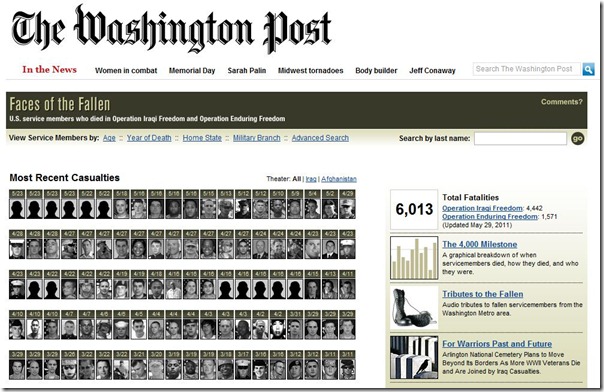
According to The Washington Post and their website “Faces of the Fallen,” the United States has lost 6,013 soldiers in the wars in Iraq and Afghanistan.

What a tragedy.

In an age of voluntary enlistment in our armed services, a small percentage of American families experience the anxiety of seeing a young man or woman sent off to war. Few feel the awful pain of being told that their 20-year old has died serving his or her country.

In fact, most of us feel no pain at all, with the exception of long security lines at airports. Instead of feeling the pain of war and making personal sacrifices so that America can be at war, Americans are encouraged to live life as if nothing is going on out of the ordinary.

In light of the terrorist attack of 9/11, President George W. Bush’s plea to the American people was to shop. "Get down to Disney World in Florida," he told us. "Take your families and enjoy life, the way we want it to be enjoyed." I understand Bush’s strategy. He wanted to not allow terrorism to disrupt the American consumer’s way of life.

He never raised taxes to actually pay for these wars. In fact, he cut taxes. His administration made sure we were made aware of terrorism (with those long lines at the airports and the multi-colored terrorist threat warnings), but we were intentionally distanced from the wars themselves.

Americans were asked to “support the troops” (who wouldn’t do that?) which meant that we were to salute their sacrifice for our way of life here in America (and not question why we are fighting these wars). But what that actually happened was this: We ended up pretending that we are really not at war. We never felt the economic hardship of having to pay for these wars. We just went to Disney World. We lived in the “World of Make-Believe.”

Face it: War has become just one of those things we do now. We send our volunteer troops all over the world to fight in battles all the time. The average American does not have a say in the matter. Heck, Congress (the ones that are supposed to represent us) doesn’t even have to declare war (as the Constitution mandates) anymore. A president can simply send our troops into harm’s way with his own authority (as long as he can play politics enough to scare members of congress that they’ll be seen as unpatriotic if they resist).
I propose two ways that we can stop our country from fighting in so many wars:


1. Reinstate the Mandatory Draft. While conscription has proved to have a lot of problems (and thus was halted in 1973), if every American had a stake in our country’s choices about war, I think we’d hold our elected officials more accountable. We wouldn’t have such a complacent attitude about war if it wasn’t just those who volunteered to fight who are in harm’s way, but our own sons and daughters.


2. Mandate that All Wars Are Paid For. I find it fascinating that in all the recent debates about budgets and deficits and spending cuts, our leaders almost always skirt around the issue of paying for our war efforts. We hear the call for “PayGo” legislation, where any spending projects must be paid for with tax increases or cuts in spending in other areas. Why not “PayWar” legislation, where any wars that the President feels we must fight must first be paid for with tax increases and/or cuts in other areas?

The website costofwar.com has a running total of the combined cost of the wars in Iraq and Afghanistan. Here is a screenshot I took today:
costofwar

We wonder why we are in the financial mess we’re in now. Look at those numbers! Nearly 1.2 Trillion Dollars spent in the last decade.

And remember that these wars are not a part of the national budget. Remember that the American people were never issued a War Tax to pay for these wars. Remember that War Bonds were never issued for our purchase to fund these wars.

We were just asked to continue our merry way, shopping and consuming, playing and pretending that war has no cost.

Oh, but we would occasionally having patriotic services on Memorial Day for the fallen. That’s good, I suppose.

So, my proposal gets at two of the places where Americans would hurt the most if we are ever to go to war: (1) our families and (2) our bank accounts. Unless we begin to feel real pain, we will continue to see more and more faces of the fallen on The Washington Post’s website.

5/26/2011

The Christian Life is a Peach, Not an Orange


orange-segmented-life-01

How would it revolutionize discipleship, evangelism, and culture-shaping if Christians saw their lives not as oranges (made up of compartmentalized, separate, sealed segments—some important to God and some not) but as peaches (a single fruit, with God at the Core, where all of life is important to God)?

LICC (London Institute for Contemporary Christianity) articulates what I’m trying to do with my ministry perfectly. Thanks to Mark Greene, the Executive Director of LICC for this video:

5/22/2011

5/20/2011

Governmental Political Solutions are Not Ultimate

One of the reasons I've been participating in the Q Gathering conversation is because this group of Christians embrace all the options for cultural change available to us.

Gabe Lyons
Gabe Lyons helpfully delineates seven channels of culture:
  1. Media
  2. Education
  3. Arts and Entertainment
  4. Business
  5. Government
  6. Social Sector
  7. Church
When people embrace their place in one or more of these culture channels (based on their gifts, passions, education, skills, training, influence, etc), they can then produce major change.

Notice that Government is certainly one of these channels. Notice, also, that Church is another one of the channels. Not the only channel, but one of them. There are a lot of other ways we can bring about change.


I submit that when we place our hopes in only one channel, we do so at our society's peril.

Government is not the end-all cure-all to our societal problems. Our American society has fallen into this belief-system. Many people believe that in order to change our society, we must do so politically. Lots of money, time, and energy goes into attempting to pass laws and elect people that will solve society’s ills. However, when we place our faith in government, I believe that we have edged toward what the Bible calls idolatry.

By the way, I also believe that the Church is not the end-all cure-all to our societal problems. There has been a terrible history of Christians believing that God’s solution to the world’s ills is the institutional church. But this is idolatry as well. The Institutional Church is not Christ nor is it Christ’s Kingdom. An institution does not save the world. The people of God are called to be the witness of Christ and his Kingdom.

Back to my main concern: What I fear is that many people have a religious devotion to Politics. Our faith systems revolve around who people will vote for, what issues will be on the ballot, how we can save the world from the bad guys (the “bad guys” are those of opposing political ideologies).

Politics has its place, and we need people who will understand political issues deeply and be political activists. This is a legitimate cultural channel. I have many friends who reside in D.C. who are on the front line of this battle.

But here’s the rub: When we switch over to believing that our particular political ideology has salvific power, we no longer are being (a) realistic, and (b) honoring the only one who indeed provides salvation.

5/17/2011

Huckabee is Gone: Will Republican Politics Find Compassionate Conservativism Again?

Mike Huckabee announced that he will not pursue the Republican nomination. That’s too bad. As Ross Douthat wrote in his op/ed, “A Requiem for Huckabee,”
“He’ll be missed in the 2012 race, and not just because his absence promises to dramatically reduce the entertainment value of the Republican debates.
He’ll be missed because he embodied a political persuasion that’s common in American life but rare in America’s political class. This worldview mixes cultural conservatism with economic populism: it’s tax-sensitive without being stridently antigovernment, skeptical of Wall Street as well as Washington, and as concerned about immigration, family breakdown and public morals as it is about the debt ceiling.”
Huckabee definitely had his flaws. Sometimes he said things without thinking just to win political points (as when he said that Obama grew up in Kenya and was inculcated with anti-imperialist political ideas by his father and the Mau Mau Revolution, when in fact Obama was born in Hawaii and spent his early years in Indonesia and did not even travel to Kenya, his father’s birthplace, until later in life).

But what Huckabee represented was a unique place in politics: An understanding that compassion for people must trump towing the party line on all things. He appealed to those of us who Douthat calls the “disaffected demographic” – “whose hostility to big government coexists with anxieties about corporate power.”

Salon's David Weigel wrote yesterday in his article, "Huckless: Mike Huckabee's decision marks the end of compassionate conservatism":
"Without Huckabee, this race actually shifts further to the right.
That's because Huckabee is (or was) the last Republican with real national political pull who didn't believe in economic conservative orthodoxy. He believes in an activist government. He favored a smoking ban in Arkansas, and for a while he favored expanding it to all 50 states. He's OK with Michelle Obama running an anti-obesity campaign from the White House. (Bachmann said the first lady was implementing a "nanny state," and most conservative voters agree with her.)
If that seems like a minor spat, it wasn't—it comes out of Huckabee's philosophy about what government should do. In December 2007 and January 2008, he feuded with Rush Limbaugh, who said Huckabee was simply ‘not a conservative’ given his views of what government was good for.”
What we had in Huckabee was someone who found the new Tea Party libertarianism immoral, and that the Republican Party is going in the wrong direction. Weigel shared something that Huckabee said in an interview:
“'The greatest threat to classic Republicanism is not liberalism,' he told reporter Will Mari. 'It's this new brand of libertarianism, which is social liberalism and economic conservatism, but it's a heartless, callous, soulless type of economic conservatism because it says, 'Look, we want to cut taxes and eliminate government. If it means that elderly people don't get their Medicare drugs, so be it. If it means little kids go without education and health care, so be it.'"
In an age when evangelical Christians are caricatured as pro-wealth, pro-big business, pro-war, anti-help for the poor, anti-care for immigrants, anti-government, Mike Huckabee (an ordained Southern Baptist minister) stood out as someone who actually tried to figure out how government could work for the common good… maybe even for Kingdom principles. He didn’t always get it right, but at least he was trying to think above the fray of political rhetoric.

Will there be another?

5/16/2011

For and Against:

  • For: Cultural conservativism that takes seriously the notion that sometimes change is not always best. 
  • Against: Cultural conservativism that unthinkingly thinks that all things were better "in the good old days" (as if they actually had existed).
  • For: Economic populism that realizes that corporations do not often pursue the best interest of the common good.
  • Against: Economic populism that believes that government will do any better.
  • Against: Rhetoric that demonizes the government, as if it is the greatest evil facing society.
  • Against: Rhetoric that demonizes business corporations, schools, trade associations, families, churches, or any other social structure needed for a healthy pluralistic society.
  • For: An economic system where people are free to pursue an abundant life, unencumbered by unjust laws and corporate greed.
  • For: An economic system where people share their resources for the common good, including a tax code that has those who have more pay more.
  • Against: An over-reaching government that extends too far into social spheres that are better handled by others (because the government does not have the expertise or locality to solve most of the problems that face us).
  • For: Universal flourishing of all, what the Bible calls Shalom.
-

5/10/2011

The People of God or The Corporation of God?

I’ve been often troubled by the fallout from the 1886 Supreme Court decision, Santa Clara County v. Southern Pacific Railroad, which applied the Fourteenth Amendment to corporations, granting them the right to be recognized as persons. As Skye Jethani writes in his excellent book The Divine Commodity: Discovering a Faith Beyond Consumer Christianity,
“Ironically, the same law that ensured human beings would no longer have legal status as property was used to grant property the legal status of human beings” (p. 90).
Jethani then connects the dots between that decision and how we now emotionally, psychologically, and theologically convey personhood to institutions. Because of branding, we don’t just buy oats, we buy from “a smiling Quaker man;” we don’t just drive a car, we shout, “I love what you do for me, Toyota!” “…as if the carmaker was a benevolent individual and not 300,000 anonymous employees organized into a profit-driven multinational institution. One hundred years of relating to personified corporations has caused a profound shift in the way we live” (p. 91).

Jethani connect the dots all the way to the institutional church, which we have personified like other corporations. We therefore believe we are supposed to have a relationship with the institution of the church rather than the people of the church.
“As such, with all sincerity, we can say, ‘“I love what you do for me, Faith Community!’ The personification of institutions in our culture means the institutional church, rather than the flesh-and-blood people of God, has become the vehicle of God’s mission in the world.”
Thus, we who lead the church as pastors start to believe that our job is to create a corporate brand, a church institution that people will be loyal to, that will have a positive reputation in the community, that our members will invite their friends to.

We develop vision statements, create programs, and we use slick marketing tools (including contemporary logos), all because we believe that the mission of God is to get people to “buy in” with our church, devote themselves to our programs, and in so doing, they will become deeper disciples of Jesus Christ.

But as soon as we start believing that the goal is to sell people warm feelings about the church, then we are way off the mark of God’s true mission for his church. The mission of God is the redemption of His creation. In other words, God is ushering in His Kingdom. The institutional church is not the Kingdom of God, but rather the witnesses to the Kingdom.

Instead of placing the emphasis on marketing the church, the church should be equipping its people to be the witnesses of the Kingdom. It is the “flesh-and-blood people of God” that the Spirit indwells in order to be the incarnational-missional instrument for the Kingdom.