11/24/2004

On the globalization of economy


Tom Sine's Mustard Seed Versus McWorld is an essential book for Christians to understand the future effects of the developing global economy, and offers very practical ideas for Christians to offer Christ's "Mustard Seed" faith within it.

Here's a couple quotes from Sine:
"One of the essential conditions of economic globalization is that all businesses have unlimited access to the global labor pool to produce goods as efficiently as possible. This viewpoint insists that the employer has no responsibility either to the worker who loses his job in a car plant in Flint or to the worker who replaces him in Juarez. The employer’s singular responsibility is to show shareholders a profit. It is up to the free market to sort out the future for those in Flint whose jobs went south. And it is up the free market to set wages of workers in Juarez, even if the going wage is not enough to provide a decent way of life for their families.” (p. 59)

"Is the ultimate vision of 'something better' to be defined primarily in terms of economic growth, centralization, and efficiency, or is there something more?...Many of the advocates of this new global order define the ultimate primarily in economic terms. It appears that we are traveling into a future in which virtually everything in God’s creation, including human beings, will be reduced to a commodity and assigned a price…Deep down I think that most of us are not keen to see our lives and God’s creation reduced to an economic value, and McWorld is not our home. As followers of Jesus Christ, aren’t we sojourners in search of a better homeland?” (p. 67)

11/16/2004

N. T. Wright on Redemption

Here's some of what N. T. Wright says in his excellent lecture, Creation and New Creation in the New Testament


Redemption is not:

  • just making life in creation a little bit better (as the optimistic humanist or evolutionist would suggest)…
  • a matter of rescuing spirits and souls from the evil of a material world (as the Gnostic would suggest)…

Redemption is:

  • the remaking of creation once evil has been dealt with.
  • the remaking of creation began with Christ's resurrection (inaugerated eschatology), in which God redeems his image-bearing people (Christians) to begin the work of redemption in creation here and now (that's why we pray, "Thy Kingdom come, Thy will be done on earth as it is in heaven")
  • the remaking of creation will come to fruition (future eschatology) when Christ returns to eradicate evil once and for all.
  • Therefore it is not one extreme or the other (as the two sides above indicate), but something else altogether (which those two extremes hint at). God is indeed (a) calling us to work toward doing good in the creation today seeking to improve the condition of life (though we do not expect to ultimately succeed in creating a utopian existence without God's future intervention), and (b) we await a time when we will ultimately be made anew by God (though not in some diembodied spiritual future, disconnected with our created physical existence in creation).
Western Christianity has been influenced by Greek philosophy: we've bought into Plato’s vision of disembodied souls entering bliss rather than the biblical picture of a physical "New Heavens and New Earth."

Romans 8:19-22 is not treated with the weight it needs to have—it teaches the renewal of all creation. Yet this section of Scripture is treated as mere embroidery around the edges of what we feel is "really important": the emphasis on individual, personal hope of heaven (at the expense of the larger picture of God’s redemption of all creation.)

"19For all creation is waiting eagerly for that future day when God will reveal who his children really are. 20Against its will, everything on earth was subjected to God’s curse. 21All creation anticipates the day when it will join God’s children in glorious freedom from death and decay. 22For we know that all creation has been groaning as in the pains of childbirth right up to the present time." (Romans 8:19-22)

By the way, this has implications on my "environmental wackoness":
“If the second coming is about people being snatched away from this present world to live somewhere quite other, you probably don’t need to bother too much about transforming this world; if the second coming goes with the expectation that God is going to redeem creation, we have a mandate already.” --N. T. Wright


see www.vanguardchurch.com for more


11/15/2004

Knowing the "Right Answers" does not mean you "Believe" them


“Knowing the ‘right answers’-knowing which ones they are, being able to identify them-does not mean we believe them. To believe them, like believing anything else, means that we are set to act as if they (the right answers) are true and that we will do so in appropriate circumstances. And acting as if the right answers are true means, in turn, that we intend to obey the example and teachings of Jesus…

The idea that you can trust Christ and not intend to obey him is an illusion generated by the prevalence of an unbelieving ‘Christian culture.’ In fact, you can no more trust Jesus and not intend to obey him than you could trust your doctor and your auto mechanic and not intend to follow their advice. If you don’t intend to follow their advice, you simply don’t trust them. Period.”

–Dallas Willard, Renovation of the Heart, p.88

11/14/2004

Am I an Environmental Wacko?

I've heard it from more Christians than I'd care to count: anybody who stands up for the ecological issues is an "environmental wacko."

I think it is unfair rhetoric to call all who are concerned with the environment a "wacko."

I agree that secular environmentalists are often guilty of turning the environment into a god to worship--which is idolatry, and is certainly "wacko."

But I am an environmentalist not in that same vain as that. I am an environmentalist because my Christian Theology demands it. Humanity's original mandate is to be the Image of God, which means (among many nuances) that we are God's vice-regents, having dominion over the planet--we are to "take care of" God's creation (Genesis 2:5).

In redemption, God's purpose is to restore our original nature--the image of God in us is redeemed. We are to again be his vice-regents in the Kingdom of God, doing God's will on earth as it is done in heaven. We are to live as an eschatological people--we are to live in the here and now as the incarnation of our future hope, living out our mandate to reflect God as His Image (back to God in worship, and out into creation in "taking care of it” by reflecting God's love and care and compassion and grace).

Our Western Christianity does not take Romans 8:19-21 ("the creation itself will be liberated from its bondage to decay") seriously, thinking that this created world is not part of the redemption of Christ, that our souls will be whisked away and this physical world will be destroyed and replaced. We have a tendency toward almost a Gnosticism (thinking that the physical world is evil because it is material, and the spiritual world is good because it is immaterial) instead of remembering the biblical teaching that God created a physical world that was “very good.” We forget that redemption (as found in the end of Revelation) includes a renewal of the entire cosmos. Redemption is the remaking of creation once evil, which has distorted and defaced creation, has been dealt with. As N. T. Wright says in his lecture Creation and New Creation in the New Testament, “If the second coming is about people being snatched away from this present world to live somewhere quite other, you probably don’t need to bother too much about transforming this world; if the second coming goes with the expectation that God is going to redeem creation, we have a mandate already.”

As we live out this mandate in the here and now, we are going about the work of pronouncing the GOOD NEWS OF THE KINGDOM OF GOD. In our participating in doing God's will on earth, we are involved in God's Kingdom invading and taking over the evil Kingdoms of this world. Kingdom work is not only “saving souls from Hell and getting them into Heaven” but also participation in every way God’s will needs to be done on earth RIGHT NOW as it is done in heaven.

One of the "kingdoms" of this world (among many) that destroy lives which God wants to liberate people from is the Kingdom of Greed/Unfettered Capitalism/Economic Globalization (see Tom Sine's book Mustard Seed vs. McWorld).

Here is why I am offended with being called an environmental wacko:
When corporate greed (and our greed in wanting fat portfolios because of the stockholder economy we live in) overrides our mandate to care for God's creation, it is THEN that we are being idolatrous!

In our proper fear of being idolatrous of the environment, we are not taking seriously enough our idolatry of what causes ecological destruction. “Since the leaders of McWorld view economic growth and efficiency as the greatest good, creation is viewed as simply a resource to be used in the cause of accelerating economic growth. This has fostered a reductionistic view of God’s creation and has placed major areas of the environment in peril.” (Sine, p. 63)

Or, as the National Association of Evangelicals say in the new statement For the Health of the Nation: An Evangelical Call to Civic Responsibility, “Human beings have responsibility for creation in a variety of ways. We urge Christians to shape their personal lives in creation-friendly ways: practicing effective recycling, conserving resources, and experiencing the joy of contact with nature. We urge government to encourage fuel efficiency, reduce pollution, encourage sustainable use of natural resources, and provide for the proper care of wildlife and their natural habitats.”

This statement by the NAE is not “environmental wackoness.” It is sound theology applied to a desperate situation in our nation and world today.

11/05/2004

Bush is the Winner! Kerry is the Loser!

I find it amazing how all the news channels and talk shows are talking about the Bush campaign tactic of wooing the evangelical vote. It's the major news story of this election: Republican strategist Karl Rove's tactic of appealing to this group of people and getting them out to vote in reation to their feelings about abortion and gays.

According to this election, the only issues that evangelicals really care about are abortion and gay marriage. This is how the media sees it, this is how Karl Rove saw it, and the results of the election seems to prove it to be true.

The message that we championed (initiated and led by Jim Wallis of Sojourners Magazine) failed. tWe tried to get across the point that Christians need to be more than one-issue voters.

We were unable to get evangelicals to think more holistically about issues. The message we tried to tell people is that Christians need to define more broadly the important "religious issues" in our society.

The Bush campaign succeeded to team with the Religious Right to keep the focus solely on gay marriage and abortion. The Falwells and Robertsons and Dobsons even said that good Christians could only vote for the president, and let it be known that they were sure that Bush was God's candidate.

But Wallis rightly insisted God is not a Republican (or a Democrat).

He was also right in pointing out that poverty is also a religious issue, pointing to thousands of verses in the Bible on the poor.

The environment - protection of God's creation - is also a Christian religious concern.

And I am one of millions of Christians in America who believe the war in Iraq was not a "just war."

And I also contended, along with many (including PBS's Bill Moyers) that the Bush Administration lacked integrity in how they over-sold the war by stretching their intelligence reports to include Saddam Hussein's alleged nuclear capabilities. (Now, Moyers and I may be wrong in that contention, but it certainly is worthy of Christian dialogue, instead of unquestioning loyalty to an "evangelical Christian" president.)

In any case, our message that Christians should be discussing many "religious issues" in this election (poverty, hunger, creation care, greed, health care, peace, along with abortion, stem-cell research, and homosexual marriage) failed.

But, to be honest, there is only so much that Wallis, et. al. can do if the candidate (in this case John Kerry) fails to embrace that message.

It was not until the very end of Kerry's campaign that he began to talk about his religious beliefs and how they might influence his decision-making. This was the most religiously-focused election in recent memory, and yet Kerry refused to engage in that conversation!

He deserved to lose because of that.

Until the Democrats come to terms with the fact that a vast majority of people in America are deeply religious, they will continue to fail to win their votes.

As Wallis famously said earlier this year, when it comes to the most important "religious issues" in our country, "The Republicans get it wrong, and the Democrats just don't get it." Bush defined religious issues as one or two things, and so he is the winner. Kerry refused to be aggresive in pointing at other issues as important religious issues, and so Kerry is the loser.

But until either party can more clearly communicate how their views will impact a complete range of Christian "religious" concerns, we are all losers.

go to my main website, www.vanguardchurch.com

10/28/2004

Does a Christian Have to Vote Republican?

A pastor friend of mine, Byron, commented below that he thinks that if we conflate our conservative Christian beliefs with conservative public policy, we have a problem.

Well, my friend, we DO have a problem!

If you listen to James Dobson, Jerry Falwell, Pat Robertson, or D. James Kennedy, they make it clear that there MUST be a 1-to-1 correspondence--that if you confess to be a Christian, you must vote for Republicans (and conversely, if you fail to vote for Republicans then you might not be a real Christian).

Further evidence: At a pastor's gatherings I attended, I asked if the pastors thought Jesus would be a Democrat or a Republican. You would have thought I had spoken blatant heresy! The general sentiment was, "Of course Jesus favors the Republicans!" And when I visit churches, the subtle undertone in conversations and from the pulpit is that Bush is God's chosen candidate, and how dare you think otherwise. Christian Coalition Voter Guides distributed in many of our churches are seen to be the gospel truth (the issues listed on it are unquestionably the only important issues for real Christians, afterall!).

We are manipulated by what Brian McLaren calls "Radio Orthodoxy" into an all-or-nothing mentality--that if we are "conservative" in our biblical beliefs, we must be "conservative" in our political and social and economic beliefs as well.

I've come to the point that I've said "ENOUGH!"

I can believe in Jesus Christ and I can trust the Bible's authority without believing that God is "Pro-War" and "Pro-Greed" and "Pro-Global Capitalism" and "Pro-Manipulation of the truth because the end justifies the means". I can be a Christian and still question this president's actions in taking our country into a pre-emptive war, his lack of plans to bring about a peaceful solution there, his favoring capitalism over the environment, his taxation plan that arguably makes the rich richer and the poor poorer, and his administration's budget dificit which purposefully squeezes out government care for the needy in our country and keeps our country from freeing up the debt of countries in deep trouble. And I can get very upset when a professing Christian consistently stretches the truth and/or outright lies in order to get elected.In other words, as a Christian, I can be (I MUST BE!) truely independent of political party affiliation.

I've read Steven Waldman of Beliefnet say "the President's supporters have repeatedly implied that God was partly responsible for Bush's election," and a recent article from Peter Wallsten of the LA Times on how some Christians are "conflicted — torn between their religious convictions on so-called values issues," and other important issues "such as jobs, healthcare, the Iraq war and the environment."

Thoug I am not a "bumper-sticker-kind-of-guy" I have this one solitary message on the back of my car now:


www.vanguardchurch.com

9/02/2004

Beyond Liberalism & Fundamentalism

I've been reading Nancey Murphy's "Beyond Liberalism and Fundamentalism: How Modern and Postmodern Philosophy Set the Theological Agenda." It's been challenging and thought-provoking, to say the least!


It has gotten me thinking about "Liberalism" and "Conservatism."

I think we had better define our terms.

Liberalism and Convervatism can mean different things in different contexts. What are we talking about? Political? Social? Theological? The difficulty is that every one of us conflate these together, and therefore have difficulty analyzing the issues in each context.

For instance, Christian Conservatives are forced to believe:
  • that the Bible is the foundation from which we believe, that Jesus is God, and that justification is a legal transaction between man and God (theology),
  • that Republicans are the only Christian choice, that western capitalism is the only Christian way to live, that the government must step in to stop abortion and gay marriages but not to alleviate poverty and care for the sick (politics),
  • and that abortion, homosexuals, school prayer, and the Ten Commandments in courtrooms are the major issues of our day (social).

Many modern Christian philosophers and theologians very often bring all these together under one umbrella. When you are a "conservative," they tell us that we've gotta go all the way!

Christian Liberals, on the other hand, are forced to believe:

  • that experience (rather than the Bible) is the foundation from which we build what we believe (and therefore we can question the Bible based on our present circumstances and the latest advances in philosophical, sociological, and psychological thought), that Jesus may have been God but that other religions offer insights into God as well, and that our salvation is more tied into what we do on earth—after all, will not Jesus separate the goats from the sheep on this basis? (theology),
  • that Democrats are the only intellectual choice, that government must step in and care for people in need, but that government must not allow a breach of the ‘separation of church and state’ for the good of both (politics),
  • and that poverty, hunger, healthcare for the needy, the environment, globalization, abortion choice, and world peace are the major issues of our day (social).

What some do is bring all these together under another umbrella.

But what we Christians need to do is this: Move into a post-conservative, post-liberal Christianity. We seek to deconstruct both sides and rebuild based on better presumptions. We need to get beyond labels and camps and get into the reality of Christ for our day. So, let's openly discuss the merits and faults of both sides in all its contexts—which will make people who have lived for a long time staunchly in one of the camps (like you and me, I would presume, coming from more conservative Christian experience) uncomfortable at times. But I'd rather be uncomfortable and authentic (by evaluating our current expression of Christianity) than to be comfortable and naïve.

We must move beyond looking at these issues in a shallow way. We should dig deep into theology and philosophy and anything else that may help to get us nearer to the truth.

Books like Murphy's Beyond Liberalism and Fundamentalism (like Stanley Grenz's works) are challenging in that they get us to the reasons why we are in these two camps in the first place. In her first chapter, Murphy explains the philosophical presumptions of modernity that have shaped both the liberal and the conservative theologies. Both conservative and liberal theologians have let Descartes' foundational philosophy invade the way we understand out theology. Foundationalism is a very MODERN way to see the world, and may have been foreign to the biblical writers.

Before we draw lines in the sand, I think we need to read these things and talk about these things and seek common ground so that we can be closer to what God has actually revealed to us about himself (as opposed to our presupposed ideas of what he has revealed, based on some fundamental modern philosophical ideas we possess).

http://www.vanguardchurch.com/

Why is Homosexuality Such a Heated Debate?

I find it interesting that the only person with the guts to respond officially to my Top 10 Issues of the Election Year (see below) did so regarding the homosexual marriage issue. (I did get a number of private e-mails about it).

It goes to prove how difficult and devisive this issue is. There are NINE other issues, just as important (some arguably more important) on the list, yet this is the one that gets a lot attention in the media and in our conversations.

Why is that?

Do you think its because we are buying into the philosophy that our sexuality is something that defines our very being?

Read the comment and my response here.

8/26/2004

Top Ten Election Issues


In a recent meeting of my Sunday night Christian community, "oasis," we discussed "Social Justice and Compassion" (one of the "six traditions of Christian faith and witness" as spelled out in our study from Renovare).

My personal exercise was to come up with what I felt were the top 10 issues in this election year.

I have been slowly but surely building a list over the past year, and the issues have naturally surfaced as I have read and prayed through this.

Here is my Top 10 - in alphabetical order:

Bioethics, Abortion, and the Sanctity of Life

Creation and the Environment

Globalization

HIV/AIDS

Hunger and Health

Israel/Palestine

Marriage and Homosexuality

Poverty, Wealth and Economics

Religious Freedom

War, Peace, and Terrorism


For in-depth information and analysis of these issues, go to
http://www.vanguardchurch.com/social_action.htm

Please let me know what your Top 10 are, so that I may re-evaluate my list in light of your comments!

8/23/2004

My recent conversation with a guy I met in a laundromat about The Da Vinci Code

While I was in Denver a couple weeks ago, I went to a lundromat in the city to wash our hiking clothes (peeeyeew!).

Seeing that the seating was sparse as I awaited for our clothes to wash, I asked a young man if I could sit across a table from him.

As I read my newspaper and he his book, I noticed that the title was The Da Vinci Code by Dan Brown. The young man was taking notes in a little notepad as he read it. I had just recently read a lot about this book, and decided to see if this might be one of those divine-appointed moments--when I can talk with a fellow human about spiritual issues.


I asked him why he was taking notes as he read this particular book. He told me that, even though he was not usually into 'conspiracy theories,' he found this book fascinating and wanted to record and research further what Brown alleges.

I said that this sounds like a great endeavor. I said that I had been reading a lot about the book and how many are really criticizing the presumptions in it. He asked me what those were. I said, “Like the presumption that the Gnostic Gospels are authentic, when most every biblical scholar knows that they date hundreds of years after Jesus, and were written by people who did not believe that Jesus could possibly be God-in-the-flesh. That’s the central tenet of Gnosticism—that ‘spirit’ is good, ‘flesh’ is bad, and therefore God could not become ‘flesh’ as the four gospels in our Bible puts it.”

“Also, how the conspiracies in the book make for great fictional reading, but there is not a shred of real evidence that has ever pointed toward a great cover-up concerning the church and Jesus Christ.”

Then I asked, “What do you think of Jesus? Was he God-in-the-flesh, or just another human?”

This was when the conversation got really good. He told me of his background in the church, how he was raised in a very conservative Christian home, and was involved in leadership in his church youth group and in a Christian organization in college. But that he just could not hide his homosexuality any longer, and ‘came out.’ He was shunned by his friends and much of his family, and the church acted as if he had the plague.

He told me that he left the church as a result, and has been seeking to figure out how to be both gay and Christian, with little hope that it can happen. All he sees is hatred for him and his sexuality in the church. He says he’s fed up with the church.

I told him that I felt the same in very many ways about the church. But not about Jesus. He is all about love and compassion—whether or not the people who claim his name are not. As we ended our conversation, as he was running late, I encouraged him to seek Jesus, not a Jesus that the church has distorted to meet their prejudices and comfort and desires…and also not a Jesus that may be distorted by his own prejudices and comfort and desires, but the Jesus that is truly revealed to us. The Jesus who loves so much that he would die for people like the both of us, in our misery and frustration and seeking meaning and wanting a deeper love than we’ve experienced.

I also encouraged him to keep seeking the truth—not just the latest fad in conspiracy theories, but the truth about God as revealed in Jesus Christ.
___

For some FAQs about The Da Vinci Code, go to http://www.vanguardchurch.com/faqs_about_faith.htm

I'm to speak August 31st

Just wanted to let people know that I have been invited to speak at
First Christian Church's ministry to young adults, "Tuesdays" on Tuesday, August 31st, 7:00 PM.


I will be speaking on "Worshiping Even When You Don't Know What God's Up To."

8/16/2004

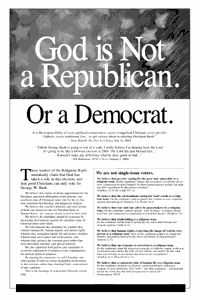
God is not a Republican. Or a Democrat.

Here is an EXCELLENT petition that lays out some of the great Christian concerns that the Religious Right (represented by Jerry Falwell and Pat Robertson) do not understand or care about.

A PDF format of the petition can be found here and you can sign the petition by going to Sojourner's "Take Back Our Faith" page.

I am currently working on a "countdown" of the top issues of this election from my personal Christian viewpoint--along with a scorecard of where George W. Bush and John Kerry stand on these issues.
Please watch the BLOG for these!

Of course, this petition from Sojourners speaks a LOT toward those issues!
So, it is a good starting point.

www.vanguardchurch.com

8/09/2004

Colorado Trip Diary

A complete, concise diary of my Colorado trip (July 31-August 8, 2004) can be found at vanguardchurch.com, including pictures!