
4/10/2006

One Year of Scot McKnight's JESUS CREED


It's been one year of blogging for Scot McKnight at Jesus Creed.

I remember when he first started--he started with a several-part series interacting with DA Carson's book that criticized the Emergent Church (especially Brian McLaren). I was in the midst of the heat of that situation, having become convinced that "Emergent" and the "Emerging Church" movement had a lot to say about where we can move forward into the "vanguard" of where the church needs to be. And Carson was one of my professors in seminary, a person I deeply respected (I own a shelf-full of his books). How he could miss the point of the EC was astounding to me, and I felt that I was one of the few "emergent-types" to try to take on his critique.

But Scot McKnight came to the rescue. Scot was another of my profs in seminary, and he has the credentials and the more thorough knowledge of theology that can take on a scholar the likes of Carson.

I remember talks on the phone with Scot last year—as he worked on that series, his insights were what I was thinking, only better articulated and better backed up with his expertise in historical theology and New Testament background.

In those early days, Scot was on Blogger, the same as I am. I have figured out how to manipulate the code of Blogger to make the blog look the way I want and to include the information I want where I want it. So I helped him design that early blog in Blogger. Then a friend of his suggested he move to WordPress, and he switched to that (which I understand is much easier to write in and has a few more bells and whistles than Blogger).

Over the past year, Scot has offered some of the best insights into theology and biblical studies on the web. He is very fair in his assessment of the Emerging Church, sympathetic to its missional call and yet not afraid to offer critique where it is needed. Jesus Creed is the best Emerging Church blog going, and that says a lot, since there are a LOT of great blogs at Planet Emergent (Emerging Church Blogs).

On a personal note, I am very touched to know that as I went through my recent brush with death, Scot consistently posted updates as to my medical condition. It is an amazing thing to go back and read those posts and the many different comments from his readers, showing their loving care for me, a fellow blogger.

Thanks, Scot, for a great year! Here’s looking forward to the next!

4/07/2006

New Pics added to the Family Page


I just added some new pictures of the family (especially the kids!) to the family page.

Pledging to Live in the Opportune Times

Reflections from the Edge of Death 2

After my surgery, I was placed in the cardio-vascular surgical ICU. But my recovery was not going smoothly. I developed Acute Respiratory Distress Syndrome (ARDS)—a life-threatening condition in which inflammation of the lungs and accumulation of fluid in the air sacs leads to low blood oxygen levels. I had to be on mechanical ventilation to deliver oxygen and a continuous level of pressure (called PEEP [positive end-expiratory pressure]) to my lungs.

During these four weeks battling ARDS, I had to be deeply sedated with medications—basically placed in a medically-induced coma—because if I would awaken, my blood pressure would skyrocket and my oxygen levels would plummet. This was a tremendously stressful time for my family and friends—a rollercoaster ride of their daily asking the nurses, “What’s his PEEP?” The higher the PEEP, the worse the news: my oxygen levels were so low that the machine had to keep my lungs expanded to help get oxygen from the lungs into the bloodstream.

At three weeks, 6 days, my wife, Linda asked my pulmonologist when I would be able to come out of the coma, and he said he did not know if or when I would. This was a jolting revelation.

The next day, by the grace of God, I woke up without complications!

That next week I would sleep a lot. But when I was awake, I found myself surrounded by family, friends, and many people I know from different local churches and even the Starbucks at which I frequent. Without my knowing it, they had been visiting me the entire time I had been in the ICU.

And it struck me: These people are precious. My life—every day and every moment—is precious. How many days have I taken life and friends and family for granted? How often have I made it a priority to love the people in my life? Not very often. God has placed me on this earth and has given me opportunities to reach out to people and care for them, and yet I had often just lived as if I’ll always have those opportunities tomorrow or next week or next year. I am not guaranteed a tomorrow or a next week—none of us are.

We named our daughter Kaira—we feminized the Greek word “kairos,” which means a measure of time, often as the “opportune time,” a specific and decisive point, a divinely allotted time or season. Kaira and her twin brother Joel were born at a particularly difficult time in our life, and we wanted to remind ourselves that God’s timing is always good.

While I laid there in the ICU, I thought of the kairos times of life—the times of opportunity that I had allowed to slip by, the opportunities wasted. I pledged to live fully in those kairos moments—“While we have opportunity (kairos), let us do good to all people, and especially to those who are of the household of the faith” (Galatians 6:10) “Therefore be careful how you walk, not as unwise men but as wise, making the most of your time (kairos), because the days are evil. So then do not be foolish, but understand what the will of the Lord is” (Ephesians 5:15). “Be wise in the way you act toward outsiders; make the most of every opportunity (kairos)” (Colossians 4:5).

The Bible passage that has been a constant comfort to Linda in these stressful times is 1 Peter 5:6-7.
“Therefore humble yourselves under the mighty hand of God, that He may exalt you at the proper time (kairos), casting all your anxiety on Him, because He cares for you.”

What a comfort—God has a kairos reserved for us as well! In those darkest times in the hospital, I wondered if I would ever see a time when I’d be home again—hugging my children, holding my wife, laughing with my friends, talking about spiritual things with my family, doing the work I love, and even blogging again…

And here I am…God has brought me through. He is good!

4/03/2006

The Power of Prayer

Reflections from the Edge of Death 1

It was 10:30 PM on Thursday, February 2. Linda had already gone to bed and had been asleep for half an hour when I suddenly felt pain in my chest that radiated to my back. I ran upstairs and woke her up, “Call 911!”

The paramedics treated me as if it were a heart-attack and rushed me to Mercy Medical Center in Canton. It took a while for the ER doctors to figure out what was wrong with me because all the tests for heart-attack came back negative. They took an X-Ray that revealed the problem: My ascending aorta that leads up from the heart had dissected—the tear had ripped through two of the three layers of the aorta and was threatening to burst, which would result in death. The aorta had ballooned, looking like a football.
I was immediately sent to surgery. Dr. Mark Tawil operating on me from 2:30 AM to 3:30 PM (yes, that's 13 hours!).

Linda had my very good friends Matt and Miche by her side (Matt drove her to the hospital; Miche, a nurse at Mercy, was working that night). Linda made some phone calls at 3:00 in the morning to friends and family and the news of the situation spread like wildfire. In those early morning hours, we were blessed to have many, many people already praying for me. By daybreak, Linda had several friends and family with her—listening to her, comforting her, and praying with her at the hospital.

This is the major news of this ordeal: By the time I had come out of surgery and was placed in ICU, there were more people than we can count praying for my life. People were praying for me from several different churches and several different states. The doctors and nurses I’ve spoken to have all said that I should not have survived. One nurse that was assisting in the surgery said that when they opened me up and she saw the aorta it was “as if somebody was holding it together.” It should have burst. Dr. Tawil stated it clearly: "It was your faith and the faith of your family and friends that saved you."

There is ongoing skepticism that prayer works in healing. Many newspapers are reporting this week about a major study published this month in the American Heart Journal—the New York Times had a front page article this past Friday (March 31) that had the headline, “Long-Awaited Medical Study Questions the Power of Prayer.” The study had total strangers praying for heart bypass patients and monitored the patients’ progress for thirty days. The report concluded that “Intercessory prayer itself had no effect on complication-free recovery from coronary artery bypass graft, but certainty of receiving intercessory prayer was associated with a higher incidence of complications.”

But the New York Times reported that “Dean Marek, a chaplain at the Mayo Clinic in Rochester, Minn., and a co-author of the report, said the study said nothing about the power of personal prayer or about prayers for family members and friends. Working in a large medical center like Mayo, Mr. Marek said, ‘You hear tons of stories about the power of prayer, and I don't doubt them.’”

I also note that the study did not consider whether or not the prayers were offered in the name of the Lord of healing, Jesus Christ. Christ tells us in several passages (see John chapters 14-16) that there is real power when we make requests to the Father in the name of Christ.

I, for one, have no doubts that it was prayer that moved God’s hand to heal me. God agreed with these prayers that I should remain alive for His glory—so that my wife Linda would not be a widow with three children to raise, and that Joel, Kaira, and Trey would have there daddy to lead them into adulthood. And that I have much more ministry to do with the CCO, the local church, and in various other ways. And that I am to re-develop my relationships with my extended family and with my friends.

This was God’s will. I have a new life to live for God’s glory. Thank you to all who prayed. Praise goes to God for his power to heal.

Next: My Kairos Lesson.

3/24/2006

I'm BAAAAAAAAACK!

I've finally come home after seven (!) weeks in the hospital.

I’m excited to be back with my family.

I’m very weak and I still get a little queasy in the stomach at times. I am to see a specialist Monday to check my ears—I can’t hear as well as I should and we want to make sure that the trauma of the surgery and long time in ICU did not cause permanent damage to my hearing.

I’m able to walk short distances and do short stints of physical therapy. I can climb our stairs in order to go to bed and take a shower—though I need supervision in case I fall.

I talked to my surgeon this morning. He told me that if I were older I would not have survived. He attributed my making it through to my faith and the faith of friends and family. So, I thank you for your prayers!! I am absolutely sure that God heard your prayers—they were powerful and effective.

The nurses and respitory therapists in the Cardio-Vascular Surgical ICU have already deemed me the miracle of 2006. They were amazing - they knew what they were doing and truly cared. Many of the nurses openly told me that they were praying for me as well.

I will be recuperating from this for a long time. I have no idea when I will be living a normal life. Sometimes this is daunting and depressing, but then I remember that I’ve been pulled out of certain death and given a new opportunity to live a life dedicated to glorifying God in every moment. My wife has been spared being a widow with three young children to raise, and my children still have their daddy. Blessings upon blessings!!

Thanks again for your prayers!

1/21/2006

The Modern Christian Response to Natural Law

Emerging Christian Ethics
Part 1: Modern Approaches to Ethics
(e) Christian Deontological Ethic

In response to an ethic like Aquinas’ Natural Law Ethic, some Christians have stressed that the only true way to know what to do or not to do is to rely solely on the Scriptures. They affirm with Natural Law ethicists that God is the God of order and absolute morality. However, they insist that there is a gap between humanity and God that is too large to be spanned by human reason. Humanity’s fallen capability to Reason, therefore, is limited to the realm of our understanding the natural world (thus affirming the sciences), but Reason cannot be brought over into the realm of ethics.

This is the “Trust and Obey” ethic. These Christians believe that what we need to do is read the Bible, the ultimate Rule Book for life, and obey the commands found there. According to this view, the most important part of being human is not, as Natural Law ethicists contend, Man’s Reason. It is Man’s Will—our ability to choose to obey God. They are confident that the Bible, plainly read and correctly interpreted, is that which humanity must obey in order to be moral.
The problems, of course, are at least two-fold. First, these Christians are suspicious of human reason, but they are attempting to make a rational argument to prove their position. Watch the line of Reason: If God is sovereign, then it he must have put in place moral requirements for humanity. If humanity is fallen, then we must distrust reason and rely on faith alone in God and His Scriptures for moral guidance. This line of argument is a rational case…so we can legitimately ask, “Why should we trust this use of Reason if we must distrust Reason?”

Second, these Christians authentically believe that the Bible is perspicuous (clear) enough to understand it in order to follow its commands. However, even if we all agree that the Bible is God’s Word to humanity that reveals His glory and His will for us, we must also say that the Bible is often a difficult revelation to interpret.

Those who insist on simply following the divine commands of the Bible actually say that we must follow certain rules of interpretation in order to understand it correctly. However, even within these ranks there are variances in interpretations, and in the larger Christian community there are even further disparities in how we understand God’s Will on ethical issues (that’s why some Christians can be for Capital Punishment and others against it, some for women in ministry roles, others against it, etc).

The problem, in the words of N. T. Wright is that “most of the Bible does not consist of rules and regulations—lists of commands to be obeyed. Nor does it consist of creeds—lists of things to be believed. And often, when there ARE lists of rules or of creedal statements, they seem to be somewhat incidental to the purpose of the writing in question…much of what we call the Bible—the Old and New Testaments—is not a rule book; it is narrative.” (Wright, How Can The Bible Be Authoritative?)

technorati: , , , ,

Aquinas v. Barth: Natural Law Ethics

Emerging Christian Ethics
Part 1: Modern Approaches to Ethics
(d) Aquinas' Natural Law Ethic

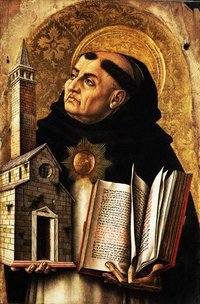
Thomas Aquinas represents the classic representation of “Natural Law” Ethics, which posits that God reveals himself in the rational ordering of Nature (what is called “General Revelation”), and thus any human being, through his or rationality, should be able to determine right and wrong.
The ultimate definition of the Image of God in humanity, according to Aquinas, is that humans are rational beings.

“To the natural law belongs those things to which a man is inclined naturally, and among these it is proper to man to be inclined to act according to reason” (Aquinas, Summa Theologica, 1-2.94.2).

Aquinas points to the evidence that every human has a conscience that tells them what is right and wrong—even the vilest of murderers values his own life.

However, the conscience needs to be trained, and that is the role of society—to properly train the conscience. Laws in society train the conscience and restrain evil, creating the environment for conscience to be developed.

Natural Law was the declared basis for the start of The United States of America. The preamble to the Declaration of Independence reads, “We hold these truths to be self-evident, that all men are created equal, that they are endowed by their Creator with certain inalienable rights, that among these are life, liberty and the pursuit of happiness.” These words tell us that the American founders believed that there was a certain natural law, and that if we use our capacity to Reason, it will become “self-evident:” We all have “rights,” including life, liberty, and pursuit of happiness.

However, Karl Barth challenged this view that even unbelievers in God can arrive at ethics through natural means and Reason. Barth counters Aquinas by saying that our ethical life is not a matter of rationally understood natural law (which relies too heavily on human reason and is merely a human invention). Barth contended that anything that humans invent really just amounts to becoming an idol, something created by us and for us. Barth says that Aquinas’ God is nothing more than a watchmaker—he created the cosmos, wound it up, and then let it go. He says that the God of Christianity is the God who actually comes to earth in human form—revealing to us the God who is not a watchmaker but a Redeemer, revealing through Christ what is right and wrong.

Of course, there is a middle ground (and this is hinted at by Aquinas himself when he insists that Divine Law is higher than Natural Law and Societal Law): Beyond general revelation is special revelation (and this is known through Scripture). Aquinas says that salvation is found in Divine Law, not Natural Law.

The middle ground is found in Reformed Theology, offering this promising resolution: The idea of "Common Grace"—the grace that is common to all humanity. It's "common" because it is experienced by all of humanity. It's "grace" because it is undeserved favor from God. And it is the possible resolution because it posits that not only does God give all of humanity general blessings, such as rain, sunshine, food, drink, clothing, and shelter, God also gives society, without necessarily renewing everyone's hearts, significant moral influence so that sin is restrained, order is maintained in social life, and civil righteousness is promoted. This is why non-Christians can have an internal sense of right and wrong, can be elected to office in order to pass, execute or judge righteous laws, and can be more ethical and more compassionate people than even some who confess Christ!

technorati: , , , ,

1/17/2006

Emmanuel Kant in Modern Evangelicalism

Emerging Christian Ethics
Part 1: Modern Approaches to Ethics
(c) Kant's Categorical Imperative

Emmanule Kant was an 18th Century German Enlightenment Modernist Philosopher, considered the most influential thinker of Modern Times. Kant’s ethic is summed up by Stanley Grenz by this sentence:
“Always do the act that is motivated by the sincere belief that what you are doing is the right thing to do, right not merely for you but for anybody seeking to act properly in any similar situation.”
Kant set out to create an ethical system that does not rely on consequences—a system that rationally determines a universal principle for all ethical decision making.

The KEYS of modernistic philosophy, epitomized by Kant, are:

  • God is not Master, Reason is Master.
  • Reason is the final legitimator of all truth; Reason is the final arbiter of ethics.
  • If one cannot legitimate something by way of Reason, it is not morally true.
  • It’s essential to have Rational Foundations to all thought.

His rational system of Ethics: “The Categorical Imperative.”
(Categorical: absolute, universal; Imperative: what one must do).
Kant taught that we can use human reason to determine the categorical imperative. Having done so, we can know what to do without any exceptions. So, according to Kant, we can take a rational approach to deciding whether or not a statement of action (a “maxim”) is ethical by testing it according to the paradigm of the categorical imperative.

Something is in line with the Categorical Imperative if:

  1. We are willing to universalize the rule of action which it generates. (Everyone who faces a similar choice must follow this rule of action—this must be everyone’s conduct).
  2. We never use people as a means to an end. (Other people are not the stepping stones to our own personal fulfillment, all people are valuable for their own sakes).
  3. We are not acting out of desire of an outcome that is beneficial to us or anybody else (such as pleasure, power, respect, fear of evil, injury, death). These cloud moral perceptions; we only act from firm convictions about what is simply the right thing to do. Ethical acts are those that arise ONLY from a sense of DUTY.

Today's Christians often say that they are in disagreement with Kant’s Ethical approach. They know that Kant is atheistic in his approach, allowing Human Reason to trump Divine Revelation.

  • However, we can readily agree that we should never use people as a means to an end, affirming with Kant that people are intrinsically valuable.
  • And, if we evangelicals earnestly analyzed our way of thinking about “truth,” we would find ourselves agreeing that ethics must be “universal” in order to be true. Many evangelicals would assert that any ethical maxim must be true across the board in all situations in order for it to be true.
  • And, many of us would say that we should act out of duty rather than allowing ourselves to be motivated by our own benefit or out of what we would hope will come out of it. Right actions are right actions, regardless of the consequences.
But we live in a murkier world than this. Often, we are faced with a myriad of choices, each carrying the banner of meeting the Categorical Imperative.

A classic example of how this creates problems is this:
What if I were in Nazi Germany, holding Jews in my home to protect them from the concentration camps? If soldiers came to my door and asked, “Are you hiding Jews in your home?” what should I do? One universal maxim is this: “I should never lie.” My maxim that I should never lie will lead to the Jews in my home to face death in a concentration camp. Is this ethical? We would also say another maxim should be, “We must not allow people to murder others.”

These two maxims clash; and Kant’s ethic offers no way out of the conflict.

technorati: , , , ,

1/13/2006

Utilitarianism, Hedonism, and John Piper

Emerging Christian Ethics
Part 1: Modern Approaches to Ethics
(b) Utilitarianism

A major ethical system that sprang from modernity is what is called Utilitarianism. It is the ethic that says we can be good through accepting the motto (to use Steve Wilkins’ "bumper sticker"), “The Greatest Good for the Greatest Number.”

Utilitarianism grew in popularity in the 18th and 19th Centuries when science became the most important of all the academic disciplines. Western culture had bought into the idea that we can better society by means of science and reason; and we could determine that which is most beneficial to society by rational, objective, scientific means. Utilitarianism is the epitome of a modern era ethic.

In the pre-modern world, we looked to authority (the Church, the King) to tell us what the “moral good” was. In the modern world, we believed we could determine for ourselves what is good by way of Reason and scientific inquiry. We looked to measurable consequences in order to determine what is good. And the question “What is GOOD?” was answered as, “That which makes life better for the most number of people.” Or, “That which makes the most people live a pleasurable and happy life.”

Jeremy Bentham (1748-1832), was a British philosopher and jurist who introduced an ethic that could be measurable mathematically. He developed the “Hedonistic Calculus” in order to determine the amount of pleasure vs. the amount of pain that any given situation may have. Bentham wrote, “Nature has placed mankind under the governance of two sovereign masters: pain and pleasure. It is for them alone to point out what we ought to do.” Therefore, we know what is good based on maximizing pleasure, and minimizing pain, and we can scientifically determine this by measuring the consequences of our actions. This was modernism's ultimate ethical system: trust in science to create a mathematical formula for ethics.

A hedonistic approach to ethics (that bases our actions on the happiness for myself and others) is not foreign to Christian thought. Twenty years ago, John Piper wrote Desiring God: Meditations of a Christian Hedonist. Piper sees hedonism as a good thing, that God has created us to seek pleasure. He insists, like atheists Bentham and John Stuart Mill, that happiness is our ultimate telos (end) of mankind; the reason we do anything is because we seek pleasure in doing it—and that’s okay. Piper claims that this is the way God has wired us. But Piper makes this qualitative distinction: Ultimate happiness is found in God alone. The problem is not that we seek pleasure, but that we seek it in the wrong things—we wrongly seek pleasure in things that do not ultimately satisfy. Food, drink, vacations, money, worldly accolades—all these are fleeting pleasures. God has created us to seek pleasure, and the only pleasure that truly satisfies is God Himself. I first read Piper a decade ago, and his “Christian Hedonism” greatly shook the way I saw my personal Christianity—I truly resonated with it.

But now I’m wondering:
As helpful and biblical Piper’s view of the Christian life is, is it holistic enough? Though he has written many volumes explaining the implications of this theology in all aspects of life, I wonder that if we start with ME and my seeking pleasure in God, does this skew my ethic away from the love for others and my love for God’s Creation? Can we, indeed, become so heavenly minded that we can become less effective in our life on earth? Don’t get me wrong, Piper’s focus on the glory of God and our seeking pleasure in relationship with God is indeed a main focus in the Christian life, But Jesus Himself did not say that that was the only thing: When asked what the greatest commandment was, Jesus answered, Love God AND love others. Both.

Not that Piper denies this, but for those of us who seek to live a Christian hedonistic life, we tend to default into a hedonistic reductionism: The only ultimate happiness is found in loving God, experiencing God, becoming immersed in the pleasures of God and God alone.

When I hear that, I want to affirm it and say, “Yes, AND…” God has created us not only to be concerned with our own pleasure—even if our own pleasure in experiencing the pleasure of God. He has also created us to love others and be care-takers of his creation. The reality of doing these two latter things is very much filled with happiness, but it is also often filled with difficulty and heartache. So, we often default to simply wanting the glorious experience of God and God alone, and we forget that the life we live in the mundane day-to-day life here on earth is just as significant for humans created in the Image of God. (Again, Piper would hate it if we misunderstood his teaching to say this—but by default, many evangelicals [including myself] have fallen into this mode of operation).

technorati: , , , ,

1/12/2006

"Greed is Good." Is it always?

Emerging Christian Ethics
Part 1: Modern Approaches to Ethics
(a) Ethical Egoism

Ethical Egoism, according to most ethicists, is the foundation of American Capitalism; Utilitarianism is the foundation of American Democracy (I'll blog on this tomorrow). So, as Americans, we obviously like and trust these approaches to ethics at some level. But a critical analysis of these two ethical systems will help us to discern what may be the strengths and weaknesses of these consequential systems.

Ethical Egoism

When Adam Smith, “The Father of Modern Capitalism,” wrote The Wealth of Nations, he laid the groundwork of our contemporary economic life. He said that in economic life, each person must seek his or her own good, unfettered by government interference. He argued that self-interest was the highest good (especially in economics) because it benefits all of society.

Michael Douglas’ character in the movie “Wall Street” explains his take as to why “Greed is Good.” (see video clip here).

“The point is, ladies and gentleman, that greed -- for lack of a better word -- is good. Greed is right. Greed works. Greed clarifies, cuts through, and captures the essence of the evolutionary spirit. Greed, in all of its forms -- greed for life, for money, for love, knowledge -- has marked the upward surge of mankind. And greed -- you mark my words -- will not only save Teldar Paper, but that other malfunctioning corporation called the USA.”

Ayn Rand (a Russian immigrant to America in 1926 at age of 21) began writing in 1943 that society functions best when we all pursue our best interests. Rand was both influenced by and became a large influencer of American capitalism. She wrote, “The first right on earth is the right of the ego. Man’s first duty is to himself.” She came to this conclusion based on REASON: she believed that we rationally understand this as the reasonable nature of things. Rand said that altruism actually weakens society: It creates people who are dependent on others, instead of being responsible for their own well-being. Rand's ethical framework, an elevation of self-interest and a skepticism of altruism, has found its home in the business practices of today's corporate America, and in the consumeristic hearts of many in USAmerica.

I wonder how American Evangelicalism has capitulated to an ethical egoism ethic. Has Christianity become too combined with the “American Dream” of individualism and capitalism? Though we won't admit it in pleasant conversation, have we emphasized personal responsibility to the point of denegrating altruism (that it is mostly enabling people to become too dependent)? Has the Gospel in modern American Evangelicalism become too highly individualized (Do we preach a message that says, “Accept Christ as your personal savior, and you will find personal peace, personal happiness, and [for some evangelicals] personal prosperity”)? Are we peddling a Gospel that has more in common with Ayn Rand and Adam Smith than Jesus of Nazereth?


technorati: , , ,

1/11/2006

New Series: Emerging Christian Ethics


(Above: Two of the books I've assigned my class)

Since I am teaching a course this semester at Malone College called "Faith and Ethics," I thought that here at the blog I'd create a series on "Emerging Christian Ethics."

Most Christian ethical systems that we operate under were forged in the Modern Era. The emerging postmodern context calls for new serious engagement with the task of ethics.

I hope to explore this in the months to come.

Please engage in the conversation!!

technorati: , , , ,

1/03/2006

The Top 10 Books I Read in 2005


2005 was another very wonderful year of reading for me. There were so many incredible books that had an impact on me that it was hard to narrow them down to five (like I did the year before). So, instead of feeling completely stressed out about it, I’ve expanded the list to 10. This helped some, but there are still books left off that I feel bad about…

Drum roll please…

10. Engaging God's World: A Christian Vision of Faith, Learning, and Living by Cornelius Plantinga Jr.
While having thought I had become “Reformed” in my theology in recent years, I have found that there are different kinds of “Reformed” out there. While I had gravitated to the Baptist Reformed ideas of people like John Piper in previous years, I now think that the Dutch Reformed ideas match more closely what I read in the Bible. In this book, Plantinga (President of Calvin Theological Seminary) offers his students a basic introduction to a Christian Worldview that sees all that we do in life defined as the redemption of God’s creative work—within the metanarrative of “Creation-Fall-Redemption.”

9. Truth Is Stranger Than It Used to Be: Biblical Faith in a Postmodern Age by J. Richard Middleton and Brian J. Walsh
In 2005, one subject in which I deeply immersed myself was postmodernity. And Brian Walsh became one of my heroes. In this book (which they had originally meant to be a re-write of their outstanding book on developing a Christian Worldview, The Transforming Vision), Walsh and Middleton demonstrate a profound understanding of both the Christian Worldview and the postmodern incredulity of the metanarrative, and have offered an intriguing way to navigate the waters that connect the two.

8. Embracing Grace: A Gospel for All of Us by Scot McKnight
Back in May, 2005, Scot’s previous book, The Jesus Creed, won Christianity Today’s 2005 Book of the Year in the category of “Christian Living.” While I enjoyed that book a lot, I was much more intimately acquainted with Embracing Grace. Scot honored me to be one of his readers of the manuscript--to offer suggestions and personal reflections. As a result, I feel a part ownership in this book. Some of my suggestions and ideas appear on the pages. Scot offers a gospel for the emerging church, one that is relational in focus and transformational in purpose.

7. Divided by Faith: Evangelical Religion and the Problem of Race in America by Michael O. Emerson and Christian Smith
Published in 2001, I just discovered this book this past year. Until I read it, I did not recognize how, as a white evangelical, I actually contribute to the racialization in our society. This is an uncomfortable book for white evangelicals to read, but I feel it should be required reading. Historically accurate, sociologically exact, and theologically prophetic.

6. God's Politics: Why the Right Gets It Wrong and the Left Doesn't Get It by Jim Wallis
In the 2004 presidential election, many evangelicals woke up to the fact that there needs to be an evangelical alternative to the Religious Right in this country. Lo and Behold, it was right there the whole time. Jim Wallis of Sojourners has been proclaiming his truly compassionate Christian political engagement for 30 years. 2004 and 2005 were the years that many heard his voice for the first time.

5. Renovation of the Heart: Putting on the Character of Christ by Dallas Willard
Willard’s insights into how to change ourselves from the inside-out need to be foundational to a Christian understanding of spiritual formation. I have been trying to lead churches and ministries in developing tools for spiritual formation for nearly two decades now, and this book BY FAR deals with the subject better than any I’ve read.

4. Heaven is not My Home: Living in the NOW of God's Creation by Paul A. Marshall
My “number one” book of 2004 was Mike Whitmer’s Heaven is a Place on Earth. Marshall’s book (1999) pre-dates Whitmer’s book (2004) and deals with the same subject of what we are supposed to be doing in our present bodily existence here on earth. Marshall’s book is more practical (but has enough biblical theology to ground its points); Whitmer’s book is more theological (but has plenty of practical insights to make it a shear joy to read). These two books are a great companion set—highly recommended for those who want to develop a Christian worldview as to why and how we live a Christian life.

3. Christianity and the Postmodern Turn: Six Views edited by Myron B. Penner
Anyone who wants to really understand postmodernity from a Christian perspective, but have only found books that outright demonizes it, needs to read the balanced essays in this essential book. The book features essays by R. Douglas Geivatt and R. Scott Smith (who are more pessimistic toward Postmodernity), James K.A. Smith, John R. Franke and Merold Westphal (who are more favorable), and Kevin J. Vanhoozer (who takes a mediating position). The second part of the book has each author interacting with the others' essays. Fascinating and insightful.

2. Colossians Remixed: Subverting the Empire by Brian J. Walsh and Sylvia C. Keesmaat
Perhaps the most important biblical commentary of the emerging postmodern age. This seminal work will set the standard on how scholars will need to interact with the biblical text in a postmodern context. Secular postmodernists will have us believe that the Bible is irrelevant, just a collection of narratives that have no bearing on any other community other than that obscure group called “Christians.” Walsh and Keesmaat prove that the Bible is relevant, intriguing, and life-changing—especially in a postmodern culture.

1. Out of the Question...Into the Mystery: Getting Lost in the GodLife Relationship by Leonard Sweet
Simply a delightful read. Not only are Sweet’s prose in this book stunning (and not quite so esoteric as has been his style in previous books), his insights into creating a Relational Theology are fresh, biblical, and life-changing (all except the chapter on Abraham, which I still am not convinced about…)

(Now, even though I included Amazon links above, you should seriously think about buying these books from Hearts & Minds instead. Byron Borger owns this independent bookstore in Pennsylvania and has these books in stock. Support this Christian brother who is doing an incredible work for the glory of God!)

technorati: , , , , ,

1/02/2006

War Propaganda Found in my Inbox


I got this forwarded e-mail
from a well-intended friend
who supports the war in Iraq:


******************
Interesting Thought for the day:

If you consider that there have been an average of 160,000 troops in the Iraq theater of operations during the last 22 months, and a total of 2112 deaths, that gives a firearm death rate of 60 per 100,000.

The rate in Washington D.C. is 80.6 per 100,000. That means that you are about 25% more likely to be shot and killed in our Nation's Capitol, which has some of the strictest gun control laws in the nation, than you are in Iraq.

Conclusion: We should immediately pull out of Washington D.C.
******************


Hmmm… That’s a very interesting statistic… But it seemed fishy to me for a number of reasons.

Since I’m not an expert on statistics, I enlisted one of my best friends, Matt Robinson (no relation), to help. Matt has his Masters degree in statistics and is now teaching stats at a local college. By the way, Matt has no axe to grind--he does not share all my criticism of President Bush and he is more supportive of the war than I am. He was, however, dismayed by the poor use of the statistics in this e-mail.

Here is a list of the misleading information that I want to point out in this e-mail's war propaganda:

1. The statistics are wrong for Washington DC.

The Washington DC annual murder rate cited is misleading, in that the author cites a number that dates all the way back to 1991. Since then (when the 482 murders in DC dubbed the city “The Murder Capital”), the homicide rate has dropped every year to a number significantly lower. During the time of the current Iraq War, the numbers have been 248 in 2003, and 198 in 2004 (with 190 so far in 2005).

So, averaging the numbers of 2003 and 2004 (223), and then dividing that number into the US Census Bureau’s 2004 population estimate of DC (553,523), we get a murder rate of 40.3 per 100,000 (223/553,523=.00040287 x 100,000 = 40.287).

BOTTOM LINE: DC’s homicide rate in the years of the Iraq War (not including 2005, which would make this number even lower) is 40.3 per 100,000, not the 80.6 that was reported (thanks, at least in part, to the strict gun laws in that city).

2. The number of months for the war is wrong.

The war is not just 22 months old. The war started on March 20, 2003. I received this e-mail on December 9, 2005. That means the war had been running for 32 months, not 22.

3. The mathematics of arriving at a “per 100,000” in Iraq number is wrong.

The standard way of arriving at a “per 100,000” is to take the number of deaths per year and divide that by the total population of that group in that year. For instance, the Washington death rate in 1991 was 80.6 per 100,000. That is arrived at by taking the number of murders in that year and dividing it by the total population of the city in that year (482 / 602,500 = 80 deaths per 100,000).
This is NOT done on a monthly basis, for this dramatically lowers the number by a factor of 12. If we divided the number of deaths in DC by 12 months, we’d get 40.166 deaths per month. If we divided that number by the total population, we’d get a much lower death rate of 6.667 per 100,000 (482 / 12 = 40.166 / 602,500 = .000666655).

The author’s numbers are therefore short by a factor of 12. His math looks like this:
2,112 troops killed / 22 months = 96 deaths per month.
96 avg. deaths per month / 160,000 avg. troop population per month = 60 deaths per 100,000 per month.

But this is not how a “per 100,000” number is found! Again, the standard is to take the number of deaths per year and divide that by the total population of that group in that year. The actual numbers look like this:
2,112 troops killed / 32 months = 66 deaths per month. That amounts to 792 deaths per year. To arrive at a “per 100,000” number, we divide deaths per year by population (792 / 160,000 = 0.00495) and then multiply that by 100,000. That makes for a 495 per 100,000 death rate among our troops!!

BOTTOM LINE: So, to correct the author’s first point, the number of American war casualties (what he called, the “firearm death rate” is actually 495 per 100,000, dramatically larger than the 60 per 100,000 he claimed.

4. The number of Coalition casualties is wrong.

In 32 months, there have been 2113 American troop deaths (not counting the 40 who had already died in December). That’s close enough to the 2112 that the author cited, so we’ll give him that one. But there have been a total of 2,314 total Coalition casualties in those 32 months. For some reason (probably because this is an argument against American withdraw from the war), the author did not include the deaths of our Coalition allies. This is rather jingoistic and dishonoring to the 201 men and women from other countries who have given up their lives in this war. Coalition forces from other countries number around 23,000.

So, when we include all coalition forces killed in the war, our number of deaths in Iraq actually drops (2,314 / 32 months = 72.3125 deaths per month x 12 months = 867.75 per year. 867.75 / 183,000 troops = 0.0047418).

BOTTOM LINE: The number of total Coalition troop deaths is actually 474.18 per 100,000.

5. The statistics are manipulatively misleading for Iraq.

Think about it. Whoever chose these statistics did this slight of hand:
Instead of looking at the total number of deaths in Iraq, they chose only the number of deaths of American troops. That would be like saying, “Washington DC has about 5,770 in its two police forces (including the DC Metropolitan Police and US Capitol Police), but only two police officers were killed there in 2004, so the murder rate in Washington DC was only 34.66 per 100,000!” Of course, that would be nonsense and nobody would put up with it. The real murder rate is 40.3 per 100,000 for the past two years (and 80.6 in 1991) because that’s based on how many civilians were murdered in those years.

So, in order to compare apples to apples, we need to know how many Iraqi civilians have been killed because of the current war. These statistics are enshrouded in mystery, but the estimates have that number, according to Reuters, is somewhere between 27,295 and 30,789. The total population of Iraq is 24,683,313.

If we take the lower estimate of civilian deaths caused by the war, divide that by the number of months of the war, we get an average of the number of civilian deaths per month (27,295 / 32 = 852.96875 deaths per month). That amounts to 10,235.625 deaths per year (852.96875 x 12 months = 10,235.625). We can now arrive at the deaths per 100,000 for Iraqi civilians (10,235.625 / 24,683,313 = 0.00041467) That’s a civilian death rate for the entire country of Iraq of 41.467 per 100,000.

And, please remember, that the statistic on the war-related deaths in Iraq is based on the total population of Iraq, not just the most violent cities of Iraq. Again, to compare apples to apples, that 41.467 per 100,000 number should be compared to the total murder rate in the United States—which is 5.5 per 100,000.

Again, if we are to compare apples to apples, the Red Cross estimates that at least 800 civilians were killed during the U.S. military siege of Fallujah in November of 2004. The population of Fallujah was around 350,000. That makes for a death rate of 228.57 per 100,000 in 2004 for Fallujah. Now compare THAT with the 40.3 in Washington DC!

BOTTOM LINE: The number of deaths in this e-mail inextricably excludes the civilians in Iraq who have lost their lives.

6. As an American in Iraq, your chance of dying is over 12 times higher than dying in Washington DC.

The probability of an American civilian in Washington DC to lose his or her life is 40.3 per 100,000. The probability of an American soldier in Iraq to lose his or her life is 495 per 100,000.

So, if we divide 495 by 40.3, we get 12.2828.

BOTTOM LINE: The author claimed that "you are about 25% more likely to be shot and killed in our Nation's Capitol" than in Iraq. The truth is closer to this: You are about 1,228% more likely to be shot and killed in Iraq than in the Nation's Capitol.

7. The Christian call in the world is promote PEACE, not to cooperate with those who would promote WAR.

As I wrote during Christmas week, Christ is the Prince of Peace, and Jesus makes it clear that his followers are called the "children of God" when they participate in his peacemaking.

“God blesses those who work for peace, for they will be called the children of God.” (-Jesus, quoted in Matthew 5:8, NLT)

I know that this war is a very complicated issue, and that the implications of "pulling out too early" are grave.

However, in our attempts to figure out what we are supposed to do, let's get the facts straight, let's not manipulate statistics to make our case, and (especially for Christians) let's begin our discussions with the presupposition that our Christian mandate is to create PEACE and not WAR. We Christians need to begin there in our discussions about this war.

Bottom Line: There are a lot of reasons not to pull out of Iraq too soon, but this e-mail's reasoning is just plain wrong.


technorati:
