10/26/2006

FREE HUGS !

The Australian band Sick Puppies have a very popular video on You Tube, featuring Juan Mann trying to show people love at a busy Sydney shopping mall.

It's very moving to see people at first shy away from this strange man holding up a cardboard sign advertising "Free Hugs."

But then it brings a tear to the eye to watch people warm up to the idea, as you watch the joy that comes simply from the innocent hug of another human being.

See the video here (click on the box to activate it, then hit the play button):


The story behind the music video can be seen here:


10/24/2006

the sol café, Edmonton, Alberta, Canada

The Organic Church On-Line Tour
featuring the insights of Bob Whitesel

Reaching a new generation in a postmodern culture will take creative thinking outside the standard church box. This is what Rob and Debbie Toews, Steve and Anika Martin, and Dave Wakulchyk have done by starting an internet coffee shop for the spread of the gospel – the sol café.

“Edmonton is cold in the winter,” says one of the leaders, “and the sol café provides a warm cup of coffee, good conversations, and time to reflect on life.”

Starting an internet café is a risky venture, and so when Rob Toews and another couple bought this business, working 2-3 shifts per day during the week to make it financially viable (while selling coffee, they were developing relationships), they had no idea how it would make it.

Here's some lessons that Whitesel provides for us:

Lesson #1: Let the worship emerge from your ambience. When going to a worship experience at the sol café, you’ll find low lighting, candles, hot brewed coffee drinks, soft music, and comfortable chairs. There is no announcement that worship has started, just a slow movement from instrumental music toward some singers, and then toward a time of joining in with singing and prayer and personal introspection. Bob Whitsel says that the emphasis is on “establishing an authentic and unhurried connection, first among musicians, then among attendees. Unveil rather than unleash.”

The teaching time is interactive. Rob Toews says, “At the sol café, interaction and asking questions are expected.” Bob Whitsel, in his analysis, writes, “Routinely, the organic church encourages didactic interaction, recognizing that young people want not to be lectured, but to be engaged.”

Lesson #2: Use self-sustaining venues, realizing profitability may sustain the venue but probably not pastoral staff. We are seeing this more and more in outreach ministry: Bookstores, Tea Bars, Art Venues, Music Shops, Coffee Houses, and more are being used as the base for outreach ministry in the urban setting. This is a difficult way of doing ministry for young pastors trying to raise families. “The sol café was able to pay our baristas $7 an hour,” recalled Rob. “But a pastor with a family is not going to live on that.” Rob now has another job as the director of a Christian retreat center. I think that denominations need to set up funds to supplement salaries of new church planters so that they can be able to do this kind of engaging ministry.

Lesson #3: The sol café literally “faces” its mission field. As the speaker sits on a stool and interacts with the people in the café, behind him is a large window that looks out onto the street. As people walk by, some gaze into the window, wondering what’s happening inside (some even walk in and order a coffee). The setup is intentional: it reminds those who have made the commitment to Christ that they are supposed to be reaching those out there on that street…that the purpose of the sol café is to be a missional community.

Bob Whitesel suggests, “Although a backdrop of street-facing windows may be impractical for many organic congregations, live video images from the street outside or nearby can suffice…(or) unfocused images behind the words of songs…can remind attendees of the daily activities and travails that go on concurrently with our worship celebrations.”

See Inside the Organic Church: Learning from 12 Emerging Congregations by Bob Whitesel (Abingdon, 2006)


technorati: ,

10/23/2006

The Tension between the “Pastoral Context” and the “Missional Context”

Having planted a church, I’ve become convinced of something. New churches in North America must move from a purely pastoral mindset into a missionary mindset. However, in the evangelical sub-culture, the leader of any church, including a church plant, is supposed to first be the people's “pastor”... that is, the church-planter is not supposed to be first the leader of a band of missionaries to affect a culture for Christ, but rather the care-taker of the people in the church.

This is a tension for church planters.

On top of this tension, most denominations want to see rapid growth from their church plants, which usually means that the church-planting pastor has to make compromises to the mission-mindedness of the project so that the church can attract Christians from other churches in order to grow quickly.

The tension is between the "pastoral context" of modern evangelicalism and the "missional context" needed to reach new people with the gospel.

True missionary work takes time and it takes sacrifice. A church planter must make mission the priority, even at the risk of not being as pastoral as most in the congregation would like.

I felt this tension. As I pastored a new church, attempting to reach a new group of people with the gospel of Christ, some of the key people in the core group of the church began to demand that I be their “pastor.” I was supposed to care for the needs of those in the church – providing programs for youth and providing teaching and worship expriences that would be pleasing to the standard evangelical ear.

The question underlying the church-planter’s calling is this: Do you care more about those “out there” than you do for those “in here?” If you appear to care more for those "out there," the evangelicals in your midst will soon resent you.

Now, here’s where the tension was found for me. I actually wanted to be their pastor, and yet I was attempting to create an environment where we would all see ourselves as missionaries. I wanted to be able to accomplish both, and my negotiation of this tension left a lot to be desired. In the end, I’m afraid I did both tasks poorly.

It takes a special person to be the leader of missionaries as well as be the pastor of a church. Perhaps this is why church planting is a unique calling. Perhaps this is why you need more than one person at the point - a team of people to perform all the nuances of church-planting ministry. Perhaps this is why so many church plants fail – denominations do not see church plants in the same light as over-seas missions and are failing to think in innovative ways to make new ventures successful in reaching people. Funding is set up poorly, long-term viability is not pursued.

The church needs to think in missionary terms instead of pastoral terms to reach a postmodern American culture. And yet, the people in the church that is being established need to be pastored.

This is the tension of church planting. Any suggestions?


technorati: ,

10/20/2006

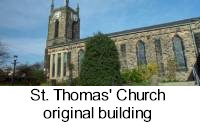
St. Thomas' Church, Sheffield, England

The Organic Church On-Line Tour
featuring the insights of Bob Whitesel

“Our story is really the story of a missional church with a clustered structure,” explains Mike Breen, former rector of St. Thomas’ Church and co-author (with Walt Kallestad, Senior Pastor of Community Church of Joy in Glendale, Ariz.) of several books that have grown out of the St. Thomas’ discipleship training, A Passionate Life, and The Passionate Church: The Art of Life-Changing Discipleship.

Innovation #1: Clustering Small Groups

While most European and Anglican churches do not grow to over 1,000 attendees, St. Thomas’ has over 1700 people (most under 40) attending. The growth came through the normal mega-church model, but the maintenance of their size came through a strange turn of events. St. Thomas’ branched out and began meeting in a large disco in town, the Roxy, featuring contemporary worship that would attract a young crowd (the stately old St. Tom’s continued to offer a standard Anglican service as well as a more contemporary one). This sounds very much like any other mega-church growth story, with all its trappings: “We filled the Roxy but were really just like most mega-churches with brittleness and disconnection,” recalls Paul Maconochie, who is now the team leader at St Thomas' Philadelphia campus.
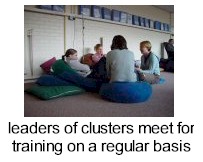
When the lease ran out at the Roxy, it forced the leadership to think creatively. They had already established small groups of 7-12 people, so their idea was to “cluster” small groups together into missional communities. These “clusters” combined 2-7 small groups together based on demographics and similar interests (for a total of about 25 to 85 people) so that they could do several things: (1) Instead of a large impersonal congregation that meets in a large venue like the Roxy, the church now meets at 17+ locations throughout the city. St. Thomas’ now looks more like a network of small churches meeting all over Sheffield. (2) These clusters provided just the right size for service to the community – Mick Woodhead, current rector (having just took over for Mike Breen) says, “Clusters are adaptable in the times they meet, the places they meet, and the ministries they undertake. And clusters are small enough to share a common vision, yet large enough to do something about it. If a small group undertakes community service, some people won’t show up and the group will be shorthanded. Soon, the small group gets burned out. But clusters of small groups can staff and maintain community ministry longer because of their size.” (Read more about clusters here.)

Innovation #2: Using Symbols for Retention and Comprehension for Discipleship Concepts

Breen and Kallestad have developed a discipleship plan that uses simple geometric shapes to train people in discipleship (See the shapes here). The thinking is that in an “icon-driven” society, young adults can latch onto these shapes and remember the implications and requirements of discipleship. The Lifeshapes© discipleship methodology has now been published for other churches to implement into their churches.

Innovation #3: Allow for Diversity of Sub-Congregations, While Maintaining Cohesiveness

Organic Churches, according to Bob Whitesel, embrace the idea of having multiple sub-congregations in order to carry out mission to the sub-populations in their community. What many modern churches seem to do is identify themselves by a particular style of ministry, limiting the number of people they can reach. The clustering format of St. Thomas’ Church allows for several different styles of churches to meet under the unified banner of St. Thomas’ Church. “Outreach thus trumps comfort.”

In order to keep cohesiveness, they schedule multiple pan-congregational unity gatherings (including a weekly Sunday evening worship event).


See Inside the Organic Church: Learning from 12 Emerging Congregations by Bob Whitesel (Abingdon, 2006)


technorati: ,

10/19/2006

The Organic Church Tour

Coming Soon:

The Organic Church Tour, featuring the insights of Bob Whitesel.

A new book has been published by Abingdon by a disciple of church-growth guru Donald McGavran (Bob Whitesel, head of Creative Church Consulting, Intl.). For each of the twelve emerging churches he profiles, Whitesel offers three leading lessons other innovative churches can learn from their model.

Churches we'll visit in the virtual reality of blogdom:

  • St. Thomas' Church, Sheffield, England
  • the sol cafe', Edmonton, Alberta, Canada
  • Mars Hill, Grandville, Michigan
  • The Bridge, Phoenix, Tempe, and Scottsdale, Arizona
  • Vintage Faith, Santa Cruz, California
  • Freeway, Baton Rouge, Louisiana
  • Church of the Apostles, Seattle, Washington
  • One Place, Phoenix, Arizona
  • Scum of the Earth Church, Denver, Colorado
  • Bluer, Minneapolis, Minnesota
  • Tribe of Los Angeles, Los Angeles, California
  • Solomon's Porch, Minneapolis, Minnesota


technorati:

10/11/2006

What gets you through the hard times

As I approached this recent surgery, friends would ask me, "Tell me, what are you learning? What is God teaching you through this trial?"

My answers to these kinds of questions seemed to be disappointing to some. They wanted to hear a tremendous new revelation, something direct-from-Godish that would be earth-shaking.

The simple answer: My theology is getting me through this hard time.

In an age where Joel Osteen smiles and blinks (a zillion times) into the camera and says that “God didn't make a mistake when He made you. You need to see yourself as God sees you” (see more Osteen quotes here), my theology of Creation-Fall-Redemption got me through.

Why is that?

Because the simplistic worldview that many Christians buy into (echoed in Osteen) is to emphasize only one of the parts of the story. If we simply believed that “God makes no mistakes in making us,” then why did I have an aortic dissection that nearly took my life back in February? Though the doctors are still unclear as to its cause, they are sure that it was caused by a congenital defect (that is, something present at birth) in my connective tissues coupled with an insufficient aortic valve.

If God “makes no mistakes,” then what the heck happened here? Saying "God makes no mistakes" does not satisfy the reality of life.

Some other Christians have another simplistic worldview: We and our world are fully evil (depraved) and under the righteous wrath of God. Under this umbrella statement, God’s good Creation is no longer good, must be destroyed, and we must escape this worldly existence into a spiritual existence. This worldview has more in common with Greek philosophy (Plato) than with the Bible. When we fail to separate out the Creation from the Fall (conflating the two into one ontological entity), our theology suffers.

My theology of Creation-Fall-Redemption got me through this trial. As my pastor prayed with me the night before the surgery, I asked him to do something that helped so much: I asked him to reaffirm with me that God is good, and that what he created is good. I asked him to help me remember that the Fall causes terrible suffering, from a crazed man killing Amish girls to Hurricanes to aortic aneurysms.

And then I asked him to pray for redemption to take place:
  • That we could see in the here and the now a glimpse of the full redemption to come.
  • That this aortic aneurysm will not win this time.
  • That Christ's redemptive power will win this time.
And redemption did win this time. Redemption in the form of a successful surgery to overcome the effects of the Fall. This is gospel; this is good news. We overcome the Fall by being redemptive in all aspects of life - be it in helping the poor, caring for the victims, feeding the hungry, sharing Christ to the lost, making people aware of the trappings of materialistic consumption, bringing comfort and healing to the sick and dying (especially those with HIV/AIDS in Africa), and, of course, through medical advances that allow for a St. Jude mechanical valve plus a synthetic replacement of my ascending aorta.


technorati:

9/25/2006

Thank you for your prayers!

I go into the hospital tomorrow for surgery (which will take place on Wednesday, Sept 27, in the morning). If all goes well (and I know we are all praying for that!), I will be in the hospital about 10 days for recovery and then home. I'm hoping that my full recovery will take only about two months.

We wanted to give a special “thank you” to all of our friends and family who have been praying for us and caring for Linda’s needs while I am in the hospital.

Watch this video! (2-1/2 minutes; Click on the image to activate the You Tube embedded video, then click on the play button)


To check on my status while in the Cleveland Clinic, you can log into "TheStatus.com" and do the following:

  • Type in my Last Name: Robinson
  • Type in the password: getwellsoon1

This page will give you the background of what has happened to me and when I’m allowed to have visitors. Linda will be able to easily update my status under “news updates.” Linda’s phone number and e-mail address are there as well so that you can encourage her!

There is a place for you to sign a guest book and/or leave a message for Linda and me while I am in the hospital. Hope to hear from you there.

You’ll also find links there for further info (maps to and of the Cleveland Clinic, info about my surgeon, etc).

Thanks again for your support.

9/24/2006

Reformed Young Christians and the Emerging Church

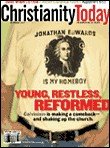
The current issue of Christianity Today features the cover story, “Young, Restless, Reformed: Calvinism is making a comeback—and shaking up the church” about how, in particular, the Calvinism of John Piper (and others, including Joshua Harris, Mark Dever, and Al Mohler) has taken young Christians by storm.

"Its exuberant young advocates reject generic evangelicalism and tout the benefits of in-depth biblical doctrine. They have once again brought the perennial debate about God's sovereignty and humans’ free will to the forefront. The evidence for the resurgence is partly institutional and partly anecdotal. But it's something that a variety of church leaders observe. While the Emergent 'conversation' gets a lot of press for its appeal to the young, the new Reformed movement may be a larger and more pervasive phenomenon. It certainly has a much stronger institutional base."

On his blog, Emergent Village’s National Coordinator, Tony Jones, wrote,

"I've spent a lot of time considering why the conservative Reformed crowd is so concerned about Emergent thinking and theology…

But it's clear that other Reformed folks are friendly toward Emergent. There's the Calvin College crowd (like Jamie Smith), the Kuyperians (like Vince Bacote), and even the Barthian-Hauerwasians (like the Ecclesia Project (Geoff Holsclaws is an example). I'm cautioned a lot by these folks not to allow the most conservative forces to define Reformed thought. (But it's interesting to note that in this month's Christianity Today cover article on young people who are joining the Reformed movement(s), there was nary a word about Karl Barth or Calvin College or the PC(USA). The entire article was about the right wing of the Reformed movement.)

My challenge to the other Reformed folks out there is to start speaking out. For instance, why doesn't Jamie or Geoff or someone else write a blog post laying out the entire landscape of Reformed thought as it's currently playing out in the American church?"


Well, Tony, at least I can serve to make the case about what you called the “Kuyperians.”

While Calvinists in the United States were fighting mainly for the doctrine of Predestination, the Calvinists in the Netherlands were developing the concept of “Worldview”—an overarching metanarrative that can explain all of life and allow Christians to eliminate a dualistic understanding of how to live. If Christ is King of all things, then it follows that nothing in our lives, in our institutions and structures, should be outside that kingly rule. All things are to be redeemed by Christ’s Kingdom.

While John Piper offers a wider-than-usual understanding of discipleship than some of the older school Calvinists who fixated only on TULIP, his Reformed Theology is still not quite a fully-orbed Calvinistic worldview, with God's Sovereignty spelled out for the various social spheres ordered into the creation by the Creator.

As Peter Heslam notes in his book, Creating a Christian Worldview: Abraham Kuyper's Lectures on Calvinism (Eerdmans, 1998),

"[Kuyper] considered the doctrine of God's sovereignty to be the fundamental principle of the Calvinistic worldview, and it was one he often expounded in his discussions of both political and cultural matters, and of theological matters. In doing so he was concerned to counter the idea that Calvinism was primarily a dogmatic position concerning the doctrine of redemption and of significance only to the church. The dominating theme of Calvinism, he explained, "was not, soteriologically, justification by faith, but, in the widest sense cosmologically, the sovereignty of the triune God over the whole cosmos."

This Dutch neo-Calvinist tradition has influenced many since Abraham Kuyper gave his influential lectures at Princeton 100 years ago, and its influence has not just been the philosophy movement that follows Herman Dooyweerd, but more broadly in the work of the progressive evangelicals from John Stott and Francis Schaeffer, the renewal of Christians in the arts (groups like CIVA, and most of the many recent books on the arts cite neo-Calvinist Calvin Seerveld), leaders in Christian scholarship (like Richard Mouw), some of the best thinking about vocation (like Os Guinness and Steve Garber), some of the most cutting-edge engagement with postmodernity (see Jamie Smith and Brian Walsh), and the cutting-edge work of the Fermi Project to engage culture, led by Gabe Lyons and Danielle Kirkland with the input of Andy Crouch. George Marsden, world renowned Christian historian, has said that Kuyperianism has triumphed in the world of Christian higher education because this stream of Christianity seeks to "integrate faith and learning" in order to help students discover the meaning of vocation. This is the goal of the ministry I help to lead, the CCO.

Christianity Today had an article (“Compassionate Evangelicalism”) that explained how thirty years ago The Chicago Declaration launched Ron Sider’s Evangelicals for Social Action (ESA). Who were there, willing to say that evangelicals must be engaged in social action? “Black evangelicals, peace-church Mennonites and Brethren, and Dutch-American Calvinists led the way in reasserting a whole-gospel witness. Representatives of these three groups were prominent in the Chicago Declaration meeting, in the early ESA, and in the ensuing movement.”

The point: Neo-Calvinists have been saying for the last century (yes! that long! “Emerging” ideas are not all that new!) that Christianity needs to be holistic, that our faith should impact every aspect of our lives, that we must be in conversation with philosophy, that we must truly live out hospitality, that we must celebrate the arts, and that political engagement must seek Justice and Shalom for all (contrary to the agenda of the Religious Right). This is the reason why the "Kuyperians" are more open to the Emerging Church conversation. What we see "Emerging" are many of the things that neo-calvinism has been advocating for 100 years.

Now that I have those two “friend of” icons in my side bar (“Friend of Emergent” and “Friend of Missional”), I thought I’d create my own. (Hey, it’s the latest fad, isn’t it?)

Check out the new web resource: “Friend of Kuyper.”

You’ll find all sorts of resources there, including the convergence between Kuyper and the Emerging Church.


technorati:

Friend of Missional

We seem to have a new title being bandied about for what we’ve been trying to accomplish with recreating the church that is capable to be in the vanguard into the postmodern culture.

The new title: The Missional Church.

Of course, this has always been the sub-title of the "Emerging Church," but what we are starting to feel is a tension—some in the emerging church conversation have wanted to re-define the gospel in ways that many of us consider to be outside the lines of orthodoxy.

Now, I’m all for exploring what the Bible has to say about the gospel (and not presume that I've figured it out). But it seems trendy in the emerging church at times to say things just to sound heretical.

Most of us engaged in this conversation are simply trying to explore the gospel as it can best be proclaimed in this postmodern culture. This is not changing the gospel, but it does change much of what church has done and said in the past 400 years.

Blogger Robbymac offers this quote from Len Sweet:

"The mystery of the Gospel is this: It is always the same (content) and it is always changing (containers). In fact, one of the ways you know the old, old truths are true is their ability to assume amazing and unfamiliar shapes while remaining themselves and without compromising their integrity."(Aqua Church, page 30)

I am still a "Friend of Emergent," for I deeply respect what the leaders of Emergent Village are trying to accomplish. And I am still a blogger mainly about the "emerging church." It will be interesting, however, to see if this new title for what we are trying to do catches on -- I sort of hope it does in that it better explains the heart of the movement.

Another blogger, The Blind Beggar, has launched a new site called “Friend of Missional.” Check it out.

technorati:

9/23/2006

The Myth of a Christian Nation – Wrap Up Review

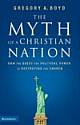
Greg Boyd is a breath of fresh air in a Christian milieu that has become active in political issues from mostly a conservative, Republican vantage point. In his book, The Myth of a Christian Nation: How the Quest for Political Power Is Destroying the Church (Zondervan, 2006), Boyd takes on the Christian Right with dogged determination.

I agree with Boyd when he says,

"A significant segment of American evangelicalism is guilty of nationalistic and political idolatry… For some evangelicals, the kingdom of God is largely about, if not centered on, 'taking America back for God,' voting for the Christian candidate, outlawing abortion, outlawing gay marriage, winning the culture war, defending political freedom at home and abroad, keeping the phrase 'under God' in the Pledge of Allegiance, fighting for prayer in the public schools and at public events, and fighting to display the Ten Commandments in government buildings." (p. 11)

However, his theological solution is to say that since there is "the kingdom of God" and there is the "kingdom of the world," all government is in the latter category and not in the former category. Not only that, but…

"Fusing together the kingdom of God with…the kingdom of the world is idolatrous…This fusion is having serious consequences for Christ’s church and for the advancement of God’s kingdom." (p. 11) "The kingdom Jesus came to establish is 'not from this world' (John 18:36), for it operates differently than the governments of the world do. While all the versions of the kingdom of the world acquire and exercise power over others, the kingdom of God, incarnated and modeled in the person of Jesus Christ, advances only by exercising power under others. It expands by manifesting the power of self-sacrificial, Calvary-like love." (p. 14)

While there is no doubt that there is a battle between the Kingdom of God and the Kingdom of Satan, Boyd mistakenly places all government into the realm of the Kingdom of Satan. This dichotomy is the basic premise of the entire book. There are two kingdoms, one of God, one of the world, and all governments are a part of the kingdom of the world—all governments are ruled by Satan.

Boyd often cites Jesus’ words in John 18:36, “My kingdom is not of this world. If it were, my servants would fight.” He therefore makes the connection that since governments fight and force “power over” others with the “sword” (see Romans 13), then government is not of God’s kingdom, it is “of this world.” He furthers this assessment by pointing out that when Satan tempted Jesus in the desert ( Luke 4:5-6), he showed Jesus “all the kingdoms of the world” and said, “I will give you all their authority and splendor, for it has been given to me, and I can give it to anyone I want to. So if you worship me, it will all be yours.” He links this to Revelation 11:15, where he sees a future in which the kingdom of the world (that is, all the governments of the world that are ruled by Satan will “become the kingdom of our Lord and of his Christ, and he will reign for ever and ever.”) In other words, all governments are actually under one authority, Satan, and Christ’s authority as the King is delayed until that time.

“The kingdom person is to remember that it’s still a 'Good Friday' world. We are to have faith that things will look different when Easter morning arrives. The ultimate hope if the world is not found in achieving victory now. The ultimate hope of the world is the resurrection, when all things shall be reconciled to God (Col. 1:20)." (p. 186)

Therefore, Boyd insists that kingdom people are to live in light of Calvary. He says that kingdom love always looks like Christ, suffering on the cross for sinners. There is certainly truth in that. Christians are to first seek to serve the people of this world, loving them as Christ did.

While I whole-heartedly agree that the Christian life must be shaped by Calvary love, Calvary is not the end of the story.

We are not living in pre-resurrection times, as Boyd puts it. We live in light of the fact that the resurrection has already occurred and that Christ has indeed triumphed over Satan. Satan is certainly still active in this world, but he is a defeated foe. The resurrection represents the dawn of the New Creation, and Christians are empowered by that resurrection God to be the very agents of redemption in this world. After the resurrection, Jesus told his disciples, “All authority in heaven and on earth has been given to me. Therefore go and make disciples of all nations” (Matt 28:18-19). The shift in authority from Satan to Christ does not wait for the future; it is already accomplished through the resurrection. Contrary to Boyd’s words, we are living in an “Easter morning world.”

In that last quote from Boyd, he cites Colossians 1:20. If we read that verse in context, it’s clear that the hope of the death and resurrection of Christ is the redemption of all things.

“16 For by him all things were created: things in heaven and on earth, visible and invisible, whether thrones or powers or rulers or authorities; all things were created by him and for him. 17 He is before all things, and in him all things hold together. 18 And he is the head of the body, the church; he is the beginning and the firstborn from among the dead, so that in everything he might have the supremacy. 19 For God was pleased to have all his fullness dwell in him, 20 and through him to reconcile to himself all things, whether things on earth or things in heaven, by making peace through his blood, shed on the cross.” (Colossians 1:16-20)

Boyd seems to think that these verses refer only to a time in the future, when reconciliation will ultimately be accomplished. Granted, we cannot say that ultimately all things are already reconciled through Christians engaging in political processes. But the emphasis of the passage is not merely on that future ultimate reconciliation but rather on the fact that Christ not only created all things (including, Boyd should note, the “thrones, powers, rulers and authorities”), all things were created “for him.” All these things, including the “powers” that Boyd insists are a part of Satan’s “kingdom of the world,” are meant to be a reconciled back to God, for “God was pleased to have all his fullness dwell in Christ, and through him to reconcile to himself all things.”

Therefore, I applaud Boyd’s arguments that the rise of the Religious Right does not best represent this Christian vision of reconciliation and I also agree that the myth of America being a Christian nation does more harm than good.

However, Boyd’s solution to the problem is to hand over the government to Satan by saying it is his for the having. According to Boyd, government is evil because it is ontologically evil; government itself is a fallen power (not just an institution that is under the influence of evil powers).

Boyd attempts at times to hedge his words by saying that its okay for Christians to participate in the political process of the kingdom of the world (as long as they know that this is not a uniquely “kingdom of God” endeavor). However, the dualism of saying that the Kingdom of God does not include political engagement in this world keeps Christians from being the fully redemptive body of Christ we are called to be in this world.

Christ is King of all things, and he is reconciling to himself all things that are not ontologically evil through his kingdom people.

___
Posts in this series:
Intro
Chapter 1
Chapter 2
Chapter 3
Chapters 4 & 5
Reflection: Boyd and Colossians 1
Chapters 6 - 8
Chapter 9
Wrap-up Review

technorati: , ,

9/21/2006

Jim Wallis vs. Tony Perkins on CBS Evening News

Tonight, the CBS Evening News with Katie Couric offered a story about how not all evangelical Christians are right-wing Republicans. The story featured Jim Wallis, editor of Sojourners Magazine in juxtaposition to Tony Perkins, President of the Family Research Council.

Couric opened the story by saying, “Many people might assume all evangelicals are conservative Republicans and speak with one voice, but more and more, this is a group that’s branching out in different directions.”

Couric doesn't quite get it right. She paints it like there has never been any other kind of politically-active Christian other than the kind repesented by James Dobson, Jerry Falwell, Pat Robertson, D. James Kennedy, or Donald Wildmon.

Jim Wallis’ Sojourners has been in existence since 1971, and other long-standing major Christian leaders have had issues with the Religious Right, including James Skillen (Center for Public Justice) and Ronald Sider (Evangelicals for Social Action). However, it is true that in the last election we have seen a renewed interest in Jim Wallis’ words, as evidenced by his book God’s Politics being on the The New York Times bestseller list for four months.

The Emerging Church has embraced Wallis (I first heard him speak in person at the Emergent Conference in 2004). The reason that he is a good match with emerging church sensibilities is that he exemplifies a post-conservative/post-liberal political agenda (what is now being called "purple politics"). Wallis refuses to allow partisan politics to guide his prophetic voice but rather attempts to be a prophetic voice into the politics of both the left and the right.

Watch the “You Tube” video of the CBS story by first clicking on the image, then on the play button.


technorati: , ,

9/18/2006

The Myth of a Christian Nation Ch 9

Book Review

In his final chapter (entitled “Christians and Violence”), Greg Boyd makes the case for a consistent Christian pacifist ethic.

Boyd answers some common questions posed to him in light of the stand he makes in this book:

1. What about self-defense?

“(A Kingdom person) would have cultivated a kind of character and wisdom that wouldn’t automatically default to self-protective violence. Because he would genuinely love his enemy, he would have the desire to look for, and the wisdom to see, any nonviolent alternative to stopping his family’s attacker if one was available. He would want to do good to his attacker.”

2. What about Christians in the military?

“Do you know—can you know—the myriad of personal, social, political, and historical factors that have led to any particular conflict and that bear upon whether or not it (the war) is justified?...Out of their cultural conditioning, most blindly assume their authorities are trustworthy, that their cause is justified, and that each person they are told to kill is a justified killing…So, while I respect the sincerity and courage of Christians who may disagree and feel it their duty to defend their country with violence, I honestly see no way to condone a Christian’s decision to kill on behalf of any country—or for any other reason.”

3. Haven’t some wars resulted in good things?

“While military victories tend to be celebrated, nonviolent victories seem to pass without notice. Most knew about Gandhi and Martin Luther king Jr., but the nonviolent revolutions that ended various unjust dictatorships and brought increased freedom for more than three million people in the twentieth century are hardly ever discussed. Consequently, we are conditioned to think violence is the only viable approach to resolving conflict…(As kingdom people), we are called to show by our life that, while violence sometimes brings about positive results, violence is never inevitable—if only kingdom people will live out their unique kingdom call.”

4. Don’t your ideas lead to passivity?

“We now find ourselves in a version of Christianity where protecting ourselves is one of the main things we stand for—“in Jesus’ name”! In the name of the one who surrendered his rights and died for sinners, we fight against sinners for our rights!...Our call is to simply live in sacrificial love and trust the sovereign God will use our love to further his kingdom, as he did with the love of Jesus expressed to us and all people on Calvary.”

5. Don’t we best serve the oppressed by overthrowing their oppressors?

“The kingdom person is to remember that it’s still a ‘Good Friday’ world. We are to have faith that things will look different when Easter morning arrives. The ultimate hope of the world is not found in achieving victory now. The ultimate hope of the world is the resurrection, when all things shall be reconciled to God (Col. 1:20). Then we will see that no act of kingdom love has ever been wasted.”
____

There’s much to be commended in this chapter. Boyd is certainly consistent and biblical.

Last week I made a trek with some friends to the United Flight 93 crash site. A temporary memorial stands there, while the funds for a permanent memorial are raised. As I looked out across the field to the pit that is now covered with grass, my gaze lowered down to the individual markers in front of me. Each person’s marker had photographs stapled onto them and family memorabilia hanging all over. Fresh flowers lie there in front of each, the fifth anniversary of the tragedy being only three days before my visit.

I read the flight recorder’s log of the final minutes and thought about the courage of those people on that airplane.

These people had to do what they did. They could not sit by passively while their plane flew toward the White House or the Capitol Building.

We are not called to be simply passive to evil; we are called to confront evil and do what must be done to eradicate it. Sometimes it takes the route of forcefully overcoming evil by force.

Boyd himself admits that these are hard matters.

I consider myself more a pacifist these days than I used to be. But pacifism does not equate to passivity. A follower of Jesus confronts evil. The best way to do so is not with more evil—we seek to subvert evil the way Christ did—turning the other cheek and then confronting it when it does indeed strike us (Jesus, when he was struck on the cheek said, “If I have spoken wrongly, testify of the wrong; but if rightly, why do you strike me?”- John 18:23).

But in a fallen world, there are times of utter desperation, emergency times in which there can be no other course than to stop evil in its tracks. The passengers and crew of United Flight 93 did just that. They did not have time to subvert the evil they confronted with loving interaction. The terrorists that high jacked that plane were not open to acts of kindness. And they were 20 minutes from Washington D.C.

I don’t know what Greg Boyd would have done if he were a passenger on Flight 93. I suspect, from his honesty in the book, that he would have been torn, but would have reluctantly joined with the rest who valiantly attacked the cabin.

___
Posts in this series:
Intro
Chapter 1
Chapter 2
Chapter 3
Chapters 4 & 5
Reflection: Boyd and Colossians 1
Chapters 6 - 8
Chapter 9
Wrap-up Review

technorati: , ,

9/17/2006

Osteen, Warren, and Prosperity

This from Ted Olsen at Christianity Today's Weblog:
____________

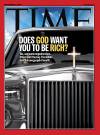
That the prosperity gospel has a hold on a segment of American culture is not disputable. Time quotes its own poll numbers:

17 percent of Christians surveyed said they considered themselves part of such a movement, while a full 61 percent believed that God wants people to be prosperous. And 31 percent—a far higher percentage than there are Pentecostals in America—agreed that if you give your money to God, God will bless you with more money. … Of the four biggest megachurches in the country, three—Joel Osteen's Lakewood in Houston; T.D. Jakes' Potter's House in south Dallas; and Creflo Dollar's World Changers near Atlanta—are Prosperity or Prosperity Lite pulpits.

For Osteen, "Prosperity Gospel" isn't a pejorative term:
"Does God want us to be rich?" he asks. "When I hear that word rich, I think people say, 'Well, he's preaching that everybody's going to be a millionaire.' I don't think that's it." Rather, he explains, "I preach that anybody can improve their lives. I think God wants us to be prosperous. I think he wants us to be happy. To me, you need to have money to pay your bills. I think God wants us to send our kids to college. I think he wants us to be a blessing to other people. But I don't think I'd say God wants us to be rich. It's all relative, isn't it?"


On the other side is the guy whose church rounds out the "largest four" list:
"This idea that God wants everybody to be wealthy?", [Rick] Warren snorts. "There is a word for that: baloney. It's creating a false idol. You don't measure your self-worth by your net worth. I can show you millions of faithful followers of Christ who live in poverty. Why isn't everyone in the church a millionaire?"


It's smart for Time to make Warren the piece's chief critic of the Prosperity Gospel. (One of his favorite lines, "I don't think it is a sin to be rich. I think it is a sin to die rich," doesn't appear.) And it allows Time to make its most astute observation: one of the reasons that the prosperity gospel has been able to grow is because (particularly white, middle-class) evangelical churches have avoided talking about personal finances or social inequality.

Now, however, white, middle-class evangelical churches are starting to talk about personal finances and social inequality. So the question becomes whether Prosperity Gospel is as ascendant as Time suggests, or whether it's just an aberrant theology that's about to have an unprosperous future.
____________

This is very insightful.

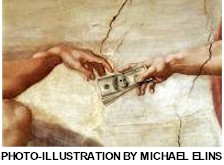
Evangelicals will overcome the prosperity heresy that has crept into the camp when we overcome the insideous overly-capitalist heresy that has long ago crept into the camp - a heresy that says that God does not care about the vast economic inequality in our midst.

We have acted for far too long like free-market American capitalists ("This is my money, you get your own!" "Look at me and all my stuff! Hasn't God blessed me since I am so rich!?") and not enough like the body of Christ (that is supposed to sell their posessions and give to each other as there are needs).

"All the believers were together and had everything in common. Selling their possessions and goods, they gave to anyone as he had need." (Acts 2:44-45)

"All the believers were one in heart and mind. No one claimed that any of his possessions was his own, but they shared everything they had...There were no needy persons among them. For from time to time those who owned lands or houses sold them, brought the money from the sales and put it at the apostles’ feet, and it was distributed to anyone as he had need." (Acts 4:32,34-35)


technorati: , ,