1/12/2012

Things the Government Has Done Quite Well

We’ve heard the suspicions, especially lately with the health care debate. People do not trust that the government can do anything well. I’ve heard a number of people use the United States Postal Service as the ultimate example. We stand in long lines at the Post Office. UPS and FedEx delivers packages more efficiently and at a better cost. Okay.

But I still think that the government has actually done some things quite well.

  1. Building the interstate highway system: We boast the best auto and truck transportation system in the world.
  2. Public Libraries: Most nations don't even have these.
  3. National Park Service: Our National Parks are amazingly preserved and managed.
  4. NASA: Not only are we the only nation to step foot on the moon, but because of the space program, our nation has developed amazing advances in materials, electronics, communications, and medicine.
  5. The Food and Drug Administration: We can actually trust that the medicine we take is what's on the label because of the government, unlike most of the world.
  6. The Centers for Disease Control: This agency has shown to be exceptional in combating emerging diseases and health risks, including birth defects, West Nile virus, avian, swine, and pandemic flu, E. coli, and bioterrorism.
  7. The Federal Deposit Insurance Corporation: Because of the FDIC, we can bank with confidence that our money will always be our money. Before the FDIC, if a bank lent more than it could support, people would lose their life savings.

So, contrary to what the pundits want us to believe, government is not always evil.

In fact, government is "God’s servant to do you good" (Romans 13:4).

1/11/2012

Miroslav Volf Against Libertarian Economics

Volf - Work in the SpiritI’ve been reading Miroslav Volf’s absolutely excellent book, Work in the Spirit: Toward a Theology of Work. In the final chapter, he moves into ways a Christian theology of work can overcome the many ways we see work in our contemporary society alienating us from being fully human. His premise is this:

“Human work, properly understood theologically, is related to the goal of all human history, which will bring God, human beings, and the nonhuman creation into ‘shalomic’ harmony.” (p. 85)

Volf (Professor of Systematic Theology at Yale University Divinity School and the Founding Director of the Yale Center for Faith & Culture) offers a pneumatological theology of work, in which the Holy Spirit gifts human beings with the abilities to provide not only for their own sustenance, but to work for the common good.

“When God calls people to become children of God, the Spirit gives them calling, talents, and ‘enablings’ (charisms) so that they can do God’s will in the Christian fellowship and in the world in anticipation of God’s eschatological new creation. All Christians have several gifts from the Spirit. Since most of these gifts can be exercised only through work, work must be considered a central aspect of Christian living.” (p. 124)

Therefore, if a large aspect of being a human is to work for the common good, then this leads Volf to criticize the economic philosophy of libertarianism, which centers on individual freedom, placing individual liberty as the most fundamental rule in economics. According to libertarian economics, we must let the free market rule itself. As individuals work for their own self-interests, the “invisible hand” of the unfettered free market transforms the individuals’ pursuit of their own interests into the public good. The best way to care for others, according to libertarian economics, is for everyone to work for themselves. The common good is best served when people do not take economic responsibility for others, but rather by seeking their own self interests.

But such an economic system rubs against the way God has created human beings.

“Individual self-interest can be pursued validly but it must be accompanied by the pursuit of the good of others. These two pursuits are not in principle mutually exclusive but complementary (though in concrete cases they often conflict). My own good and the good of the whole human family are both included in the shalom of the new creation. Therefore, no contradiction is involved when a person ‘gives himself up’ for someone and ‘loves himself’ at the same time (see Eph. 5:25-28). (p. 192)

“Unlike libertarian philosophy, Christian faith does make demands on people to accept economic responsibility for others. And these demands are not only demands of generosity. They are demands on them to practice justice. Both in the Old and the New Testaments the concept of justice includes concern for the underprivileged (see Matt. 6:1; Ps. 112:9). Paul, for instance, calls the financial help of gentile Christians to the Jerusalem poor ‘justice’ (2 Cor. 9:9). Correspondingly, the mere refusal of the wealthy to aid the poor can be considered a criminal act (Ezek. 16:49).” (p. 194)

“Important as it is, from a Christian perspective, respect for individual liberty will not suffice as a basic rule for the market game. Respect for the right of sustenance of all individuals must be added as a rule that is even more basic than respect for individual liberty. If the market will not behave according to this rule, it is the market that has to go, not the rule. For the basic criterion of the humanness of an economic system is whether or not it secures lasting justice for the poor.” (p. 195)

The answer is not Marxism, according to Volf, but “a market economy directed by a vision of the common good.” In other words, a market economy that has parameters that ensure individual freedom while also caring for the basic needs of all people.

11/21/2011

Bill Moyers: plutocracy and democracy don't mix

Wisdom. Moyers is a Christian with a bias against plutocracy. I'm with him on this.

10/07/2011

Skye Jethani’s Church-365: Assist in cultural flourishing through vocation-based discipleship

Skye Jethani’s recent posts at Out of Ur (part 1, part 2, part 3) are a clarion-call for churches to re-imagine their purpose and function. He calls the posts Church365,  challenging the church to move away from the Sunday-centric model (Church52) that pushes church leaders into a job of ensuring the perpetuity of their institutional church rather than on empowering and equipping people to bless the world.

In this five-part series (all of them are available at SkyeJetani.com), Jethani is talking my language. I am in the middle of starting a non-profit for the purpose of equipping believers in the exact ways that he articulates here, to encourage discipleship by and through believers’ vocations.

Jethani writes,
“We come to believe that programs rather than people are the vessels of God’s Spirit and mission in the world. When this occurs we begin to honor people for their involvement in, or service for, the church. But what they do with the remainder of their time gets little attention. When this assumption is reinforced over decades, a hierarchy of importance is established with church leaders (pastors and missionaries) at the top. Others are then only celebrated when they behave like pastors or missionaries, or when they leave their ‘worldly’ professions to devote themselves to ‘full-time Christian service.’”
What Jethani is asking the 21st-Century American church to do is to rediscover the Reformation’s deep theology of vocation.
“It was understood that all callings were valid before God, and each glorified him and provided a critical service in the world. In other words, the life of the painter, politician, or podiatrist is just as God-honoring as that of the priest when done in communion with Christ and for the benefit of others.”

Jethani says what I've been saying for years here at VanguardChurch.com, that churches should be offering commissioning services for everyone in every line of work. Every Christian is in "full-time ministry," no matter what they are doing, no matter what it says on their business card, no matter if they punch a time clock or are on salary, no matter if they are doing technical work or people work, no matter if they are paid or a volunteer, no matter if they work for their boss or for their family as a housekeeper.

He then interacts with David Kinnemann of the Barna Group (author of the new book, You Lost Me: Why Young People are Leaving the Church…And Rethinking Faith. In this book, Kinnemann insightfully states,
“For me, frankly, the most heartbreaking aspect of our findings is the utter lack of clarity that many young people have regarding what God is asking them to do with their lives. It is a modern tragedy. Despite years of church-based experiences and countless hours of Bible-centered teaching, millions of next-generation Christians have no idea that their faith connects to their life’s work. They have access to information, ideas, and people from around the world, but no clear vision for a life of meaning that makes sense of all that input (You Lost Me, page 207).”
I’m grateful that for the last six years, I’ve been doing ministry with the Coalition for Christian Outreach (CCO), a ministry that sees our mission as primarily that of equipping college students with discipleship that takes seriously how their vocations will be their way of living for Christ for the sake of the world.

Now, with my future NPO, I will be doing that coupled with the task that Jethani advocates here:
“(This is) going to be highly relational. It’s going to require an older believer in finance to mentor a younger one. It’s going to require church leaders to function as match-makers linking people of similar callings together for support, encouragement, and equipping, rather than imposing their pastoral calling upon all of the sheep.
It also means seeing local businesses, clinics, schools, parks, and studios as discipleship outposts of the church. Consider my friend Walter in Phoenix. Walter works in real estate development, and his heart is to help young Christians who are called into the marketplace to engage their work with Christ. He’s created opportunities over the years to mentor younger business leaders in his office. Walter’s business is a discipleship outpost.
As church leaders, our role should be to visit Walter at his business to encourage him and see how we might equip him to do his work better. This is 180 degrees from what most churches try to do--which is to get people like Walter out of their offices and into the church facilities with more regularity to support its programming. Again, its the difference between Church365 and Church52.”
I met Skye Jethani at this year’s Q Gathering in Portland, where we talked about his previous book (The Divine Commodity – one of the best books I read this year) and his new book (With: Reimagining The Way You Relate To God). His presentation at Q was my favorite (and that’s saying something, since this event was packed with excellent presentations). Check out his musings at SkyJethani.com.

9/30/2011

Waste Land: A Story of Redemption

As artists engage in the four chapters of the biblical narrative (Creation-Fall-Redemption-Restoration), they offer insight into the character of God in light of the way the world is meant to be. In my last two posts (about Banksy and Derek Webb), I looked at artistic depictions that are creative and also expose the fall, now we will look at the way art can offer glimpses of redemption and restoration.

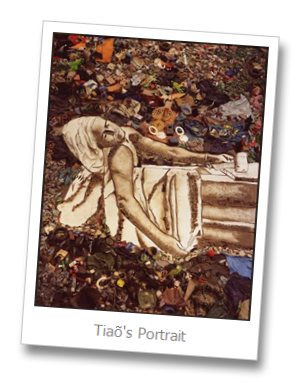
An artist that exemplifies redemption is Vik Muniz, who specializes in photographing unique physical creations and displaying them as enlarged photographs. Looking at one of Muniz’s photographs from afar, it looks like a regular image or a rendering of a familiar piece of artwork, but when examined up close, one discovers the use of various and surprising mediums, like chocolate syrup, peanut butter and jelly, plastic toy soldiers, and garbage. Muniz takes trash and discarded rubbish and transforms them into something beautiful, exemplifying the act of redemption.

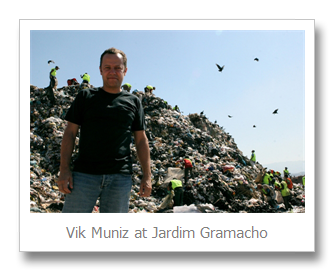
In the movie Waste Land, Vik Muniz takes a journey back to his homeland of Rio De Janeiro in order to meet those who live and work at Jardim Gramacho, the world's biggest garbage landfill.


As his helicopter first flies over the terrain of the landfill, he sees the hundreds of people working like ants, digging through the trash heaps picking out items that can be sold to recycling companies. He assumes that the “pickers” must be savages, filled with bitterness and violence.

What he finds is different.

As Muniz begins to talk with the people, getting to know their stories, he finds that the human spirit to more than just survive but to flourish, to find meaning and hope, is alive and well. There’s Tiaõ, the young, energetic president of the Association of Recycling Pickers of Jardim Gramacho. He has been a picker since he was eleven, and hopes that the fledgling union will grow in influence in order to improve the lives of the pickers. There’s Suelem, a young woman of eighteen who has been working on the garbage heap since she was seven. She has two kids and is pregnant with a third, but she is actually proud of the hard work she does at the landfill, because she has not taken the route of prostitute that she has seen many other pretty young women take.

We watch her go home after a long day of work to the loving embraces of her children. There’s Irma, who loves her role as the landfill’s chef, cooking wonderful meals for the pickers made from the ingredients that she finds amidst the fresher garbage as it arrives at the landfill.
Muniz convinces these pickers that they should let him take photographs of them in order to create his artwork. They understand that Muniz is a world-renowned artist whose artwork sells for incredible amounts of money. Muniz explains to them that by cooperating with him, he will be able to give them and their difficult work the recognition it deserves and that he will donate all the proceeds from his portraits back to the pickers.

Muniz takes portraits of the pickers in different fascinating poses, and then blows up the black-and-white images to the size of the floor of a large warehouse. In the next step of the process, Muniz has the pickers help him fill in the details of the images on the floor with all sorts of discarded trash items that the pickers have saved from the landfill for recycling. There’s old sodapop bottles, toilet seats, plastic bins, traffic cones, shoes, etc., meticulously placed in such a way that the portrait takes shape through the objects. Muriz then takes a high-resolution photograph of the final project, and frames the large portrait for display.

Irma's Portrait under constructionTiaõ accompanies Muniz to the art auction for the portraits, where the portrait featuring himself follows a piece by Andy Warhol. The final bid for the portrait was $50,000!
As Tiaõ is overwhelmed and weeps and Muniz hugs him, we experience in a very real, cathartic way the pleasure of redemption.
Tiaõ has been recognized for the work he has been doing since he was a little boy, and he now has the money to make his union flourish in order to bring dignity to the work of the pickers back at Jardim Gramacho.

Art can move us to see redemption in real, physical existence. The stuff of art is the stuff of our existence, whether it is paint squeezed out of a tube, or refuse discarded at a giant garbage dump.

When art tells the story of redemption, it is tapping into the truth of the cosmos – that God created this world as it ought to be, that things are broken and not the way it should be, but that something needs to be done about it so that there can be hope for the future. The artist, whether he knows it or not, is retelling the grand narrative of Creation-Fall-Redemption-Restoration, the truth of the gospel found in Jesus Christ revealed in the Scriptures.

9/29/2011

Subversive Prophetic Music

In my last post, I asked, “What would it look like if a new generation of Christians took seriously the task of being subversive prophetic voices in their culture?”

Derek Webb takes a prophetic stand against the homophobia that exists in the evangelical subculture with “What Matters More.”

Webb’s label, INO Records, found the song too scandalous because Webb uses the word “shit” on it, so after much wrangling, Webb and the label agreed to not include it on INO’s release of the album Stockholm Syndrome while Webb could include it on his personal website’s version of the album.
The song is a subversive prophetic voice to those of us who act self-righteous with our words against homosexuality, showing that we have our priorities out of whack about the things that really matter.
If I can tell what's in your heart
By what comes out of your mouth,
Then it sure looks to me like
Being straight is all it's about. 
It looks like being hated
For all the wrong things,
Like chasing the wind
While the pendulum swings.
'Cause we can talk and debate
Till we're blue in the face
About the language and tradition
That He's coming to save.
Meanwhile we sit
Just like we don't give a shit
About fifty thousand people
Who are dying today.
Tell me, brother what matters more to you?
Tell me, sister what matters more to you?


Besides being perhaps the first song from a Christian musician to use the word “shit,” this is perhaps the first to rage against the injustice of homophobia.

Of course, Derek Webb is not the first Christian ever to write something using a shocking word for excrement as a device to get our attention. The Apostle Paul, writing about all his past religious credentials, wrote to the Philippians,
“I count everything as loss because of the surpassing worth of knowing Christ Jesus my Lord. For his sake I have suffered the loss of all things and count them as σκύβαλον (skubalon - dung, human excrement, “shit”) in order that I may gain Christ and be found in him” (Philippians 3:8-9).
Sometimes it takes a little rebellious language to get the attention of those who are “religious” while Christ and his Kingdom demand us to change our ways.

9/28/2011

Art as Prophetic Subversion

banksy_christI have already stated emphatically that art is good simply because it is creative. Art glorifies God simply by being imaginative and original. Art’s value is not based on its instrumentality or on its commercial value. What proceeds below must not serve to undermine this foundational assertion: Good art is good art; it glorifies God “as is.”

Beyond the inherent goodness in art, there are also other ways that art can bring glory to God. Today we will look at how art can be both creative and prophetic. Tomorrow we will see how art can be redemptive and restorative.

Art can be prophetic, creating critical awareness of injustice, brokenness, oppression, and the need for action to alleviate suffering.
“Using the arts to create critical awareness is not new. In the Old Testament Jeremiah, Isaiah, Amos, and other prophets used drama, allegory, and poetry to jolt people and nations into thinking about their lives in the world. Jesus, by his presence and his storytelling, often confused and angered those around him who did not want to recognize their own role in oppressing the poor. He created critical awareness among the poor by causing them to see and act on the new life of freedom that was possible outside the accepted cultural boundaries based on status, wealth, power, religion, gender, and ethnicity.” (Taking it to the Streets: Using the Arts to Transform Your Community, by J. Nathan Corbitt and Vivian Nix-Early, p. 129)
In the movie, Exit Through the Gift Shop, an eccentric Frenchman Thierry Guetta has an obsession to videotape the secret lives of the most famous street artists as they create their art. Even though he tells the street artists he is making a documentary, he in fact has no ability to do so, he simply collects box after box of unmarked videotapes. In his exploits, Guetta meets many of the most famous street artists in the world, including Space Invader, Shephard Fairey (known for his Andre the Giant stencils and made famous through his colorful Barack Obama posters during the 2008 election) and the most famous and most mysterious street artist of them all, Banksy, whose legendary art mysteriously appears on walls, bridges, and streets throughout the world. All we know of Banksy’s identity is that he is a 30-something male from the Bristol area of England. In the film, Banksy’s face is obscured in black while he wears a hoody as he is speaks to the camera.

Banksy - No_LoiteringBanksy is one of today’s greatest creative geniuses. Most of his art is created through a unique stenciling technique (though he also creates physical props) and these masterpieces are often satirical and subversive, using irreverent dark humor to offer insightful social commentary.
banksy - palestinian wallHis art has appeared throughout the world, including buildings made derelict by Hurricane Katrina (one painting depicted an old man sitting on a rocking chair waving a small American flag under spray-painted words “No Loitering”), the wall that divides Israel and Palestine (where he created nine provocative paintings depicting escape, freedom, and beauty on an object that represents imprisonment and the ugly reality of political faction), and even Disneyland (where he placed a life-sized replica of a Guantanamo Bay detainee next to a roller coaster). When an art museum commissions Banksy to display his art, the museum is vacated while he secretly comes in and installs his art. One of his most provocative paintings depicts Christ crucified, but instead of being on a cross, his spread arms and hands are carrying shopping bags full of Christmas presents. The street prophet is asking us, “What is Christmas really about today? How has commercialization and commodification usurped the real story of Christ?”

banksy-disneylandIn Exit Through the Gift Shop, Banksy realizes that Thierry Guetta is not really a creative artist capable of making the movie and therefore takes over the direction of the documentary. Flipping the script on Guetta, Banksy suggests to the crazy Frenchman to become a street artist himself, which he excitedly does. Guetta takes the alter ego “Mr. Brainwash” and mass-produces street art for a big debut show in Los Angeles.

Banksy successfully transforms the movie into the story of Thierry Guetta, whose only talent is to copy the art of those he admires for commercial monetary success. “Mr. Brainwash’s” show is a success, as people line up and pay a lot of money for pieces of pop-art that are totally derivative of the true street artists.

Bansky’s film shows, through the character of the shallow Guetta, that not all art is authentically creative. Banksy also exposes the desire in our culture to commodify everything, even art.
So, in the film, we get insight into both the creative and the prophetic aspects of art that glorifies God.
Art is art when it is not derivative, when it is done with authenticity, and when it is not subsumed under the weight of commercialization. This is art that is done by image-bearers reflecting the creative imagination of the Creator.

Art can also be prophetic, as exemplified by the work of Banksy, whose subversive creations speak against injustice and unrighteousness. While the authorities paint over his art because they are classified as “defacing graffiti,” Banksy continues his defiant agitation of the status quo.

What would it look like if a new generation of Christians took seriously the task of being subversive prophetic voices in their culture?

9/27/2011

We Need a Vertical and Horizontal Theology of Art and Culture

love neighborIn what has been called the “Great Commandment” of Mark 12:28-31 and Matthew 22:34–40, Jesus tells us that we must love the Lord our God and love our neighbors.

Artists that want to be used by God need to embrace both the vertical and horizontal aspects of this love.

Art certainly can be a “vertical” expression of our worship of God. We should compose and play music, paint, draw, write, sculpt, photograph, film, etc. objects that directly worship God. Art that celebrates God is very important to the life of the church, for these artistic expressions are capable of moving hearts in ways that didactic teaching rarely does, making disciples through praise and worship. It is one of the primary ways that we fulfill the first of the two-part commandment—we are to love the Lord our God.

But there is a second part to that commandment that many in the evangelical church have missed when it comes to the arts. Not only are we to create art that expresses our love for God, we are to create art that expresses love for neighbor. Art is not just for the praise of God, it is to be an instrument for good to our neighbors.

J. Nathan Corbitt and Vivian Nix-Early correctly state,
“Christian artists should indeed ‘lift holy hands in praise of God’ with their arts in the sanctuary and in their lives, but they should also be challenged and encouraged to give others ‘a cup of water’ in Jesus’ name and put a song in people’s hearts through the arts in the streets outside the sanctuary…Excellent worship demands excellent love and forcefully propels this love out of the sanctuary and into the public square.” (Taking it to the Streets: Using the Arts to Transform Your Community, Baker Books, 2003, pp. 20, 21.
Nicholas Wolterstorff’s book on Art is appropriately titled Art in Action. In it, he states,
“Works of art equip us for action. And the range of actions for which they equip us is very nearly as broad as the range of human action itself…Art—so often thought of as a way of getting out of the world—is man’s way of acting in the world.” (pp. 4, 5)
This week, we will end this series dealing with Christian theology as it relates to popular art and cultural engagement by looking at ways that art can “love neighbors” through being creative, prophetic, redemptive, and through offering hope.

Subversive for the Common Good: Seek the Welfare of the City

God, through the prophet Jeremiah, not only tells those in the Babylonian exile to live holy lives, he also gives them a calling as they live in the midst of this oppressive empire.
“Seek the welfare of the city where I have sent you into exile, and pray to the LORD on its behalf, for in its welfare you will find your welfare.” (Jeremiah 29:7)
As Brian Walsh and Sylvia Keesmaat wrote,
“This call is profoundly subversive—right up there with ‘pray for those who persecute you’ (Matt. 5:44)—precisely because it is completely antithetical to all the empire could ask or imagine. The empire wants nothing more than to break the spirit and will of the foreigners in its midst. But with the call to seek the welfare of the empire, the exiles are living out of the vision and hope of Genesis, for the good of the empire itself. This is a call to be God’s people by bringing shalom and healing in places of brokenness and despair. And what could be more broken and more in need of healing than the place of oppression, the heart of the empire?” (Colossians Remixed: Subverting the Empire (InterVarsity Press, 2004), p. 68).
We who are in the Kingdom of God are called to bear witness to that kingdom within the broken world that we reside by our subversive actions for the common good.
In his first letter, Peter tells us that good deeds are the ultimate witness that Christ is Lord. As the Kingdom of God advances over the dark twisted ways of the fallen world, people will see that God is indeed good.
“Who is going to harm you if you are eager to do good? But even if you should suffer for what is right, you are blessed. ‘Do not fear their threats; do not be frightened.’ But in your hearts revere Christ as Lord. Always be prepared to give an answer to everyone who asks you to give the reason for the hope that you have. But do this with gentleness and respect, keeping a clear conscience, so that those who speak maliciously against your good behavior in Christ may be ashamed of their slander” (1 Peter 3:13-16).
Doing what is right and good is simply a practical way of stating the “Great Commandment” of Mark 12:28-31 and Matthew 22:34–40, where Jesus tells us that we must love the Lord our God and love our neighbors. How can we create cultural artifacts that are for the common good, that act as leaven in the world, transforming it from the inside out?
Next: A Horizontal and Vertical Theology of Cultural Engagement

9/26/2011

Christian Faithful Presence in the Culture

For the past month, I’ve been exploring a proper Christian engagement with popular cultural art. If Art is to be “Missional,” then artists must take seriously that the kingdom their work can act like yeast that is mixed into the culture (Matthew 13:33). In my last post, I quoted Al Wolters saying that the gospel is a leavening influence in human life wherever it is lived, which “makes possible renewal of each creational area from within, not without.”

James Davison Hunter, in his influential book, To Change the World: The Irony, Tragedy, and Possibility of Christianity in the Late Modern World, calls this “Faithful Presence.”

Christians are called to be “fully present and committed in their spheres of social influence, whatever they may be: their families, neighborhoods, voluntary activities, and places of work…to create conditions in the structures of social life we inhabit that are conducive to the flourishing of all.” (p. 247)

This “flourishing” is the Shalom that I spoke of earlier, the way things are meant to be – “the webbing together of God, humans, and all creation in justice, fulfillment, and delight” (as Plantinga says in his book).

Hunter says,
“Faithful presence in our spheres of influence does not imply passive conformity to the established structures. Rather, within the dialectic between affirmation and antithesis, faithful presence means a constructive resistance that seeks new patterns of social organizations that challenge, undermine, and otherwise diminish oppression, injustice, enmity, and corruption and, in turn, encourage harmony, faithfulness and abundance, wholeness, beauty, joy, security, and well-being.” (pp. 247-8.)
What Hunter is advocating is for Christians, through their vocations, to act in subversive ways in order to bring God’s kingdom to bear upon the fallen world, “for he has rescued us from the dominion of darkness and brought us into the kingdom of the Son he loves, in whom we have redemption, the forgiveness of sins” (Colossians 1:12-13).


NEXT: “Faithful Presence” as Subversive Art  within the Empire of Oppression

9/16/2011

Structure and Direction: A Better Paradigm for Cultural Engagement

There is a superior way to deal with culture rather than the pietistic path of arbitrarily deciding what in the culture is bad and then shunning those things.

structure-directionAlbert Wolters suggests that if we think in terms of the biblical storyline of “Creation, Fall, Redemption,” we will have a better paradigm by which to engage culture.

“Creation” is the way things were originally created, “very good” in God’s eyes. It is the “structure” that God originally intended, not just for the primordial creation, but also the latent potential embedded in the creation from the beginning which enables humanity to create new technologies and art.

“Fall” and “Redemption” are then the two opposing “directions” that humanity is now engaged in exercising upon this God-ordained structure. Thus, if we think in the paradigm of “Structure and Direction” we will be called not just to shun the things of the Fall, but rather to actively engage in changing the trajectory of those things toward Redemption.

In Creation Regained: Biblical Basics for a Reformational Worldview, Albert Wolters writes,
“This twin emphasis makes a radical difference in the way Christian believers approach reality. Because they believe that creational structure underlies all of reality, they seek and find evidence of lawful constancy in the flux of experience, and of invariant principles amidst a variety of historical events and institutions. Because they confess that a spiritual direction underlies their experience, they see abnormality where others see normality, and possibilities of renewal where others see inevitable distortion. In every situation, they explicitly look for and recognize the presence of creational structure, distinguishing this sharply from the human abuse to which it is subject.” (pp. 88-89)
This paradigm then moves the Christian toward redemptive action. It is not enough to identify that which is good, true and beautiful as opposed to that which is evil, lies and distortion. It is the Christian vocation to intentionally turn that which is in the latter categories toward God’s good intentions.

In Matthew 13:33, Jesus says, “The kingdom of heaven is like yeast that a woman took and mixed into about sixty pounds of flour until it worked all through the dough.”

Wolters writes,
“We learn for this that the gospel is a leavening influence in human life wherever it is lived, and influence that slowly but steadily brings change from within. The gospel affects government in a specifically political manner, art in a peculiarly aesthetic manner, scholarship in a uniquely theoretical manner, and churches in a distinctly ecclesiological manner. It makes possible renewal of each creational area from within, not without…
Everything in principle can be sanctified and internally renewed—our personal life, our societal relationships, our cultural activities…
What was formed in creation has been historically deformed by sin and must be reformed in Christ.” (p. 90. 91)
A “Missional” attitude for artists and for those who patronize the arts, then, is to be actively reformational: Intentionally seeking to be change agents, changing the direction of God’s good creational structure away from the depravity of the Fall and toward the re-creation of all things in Christ.

9/15/2011

Is Your View of Ministry Too Church-Focused?

In my experience in church ministries, I have found that the pastoral staffs get so caught up in the daily workings of church ministry that we often miss the Kingdom work that we are supposed to be doing. Here’s a quote that drives it home for me:

“Much of the positive Christian influence on me and my seminary friends was through people who thought that God’s most important task is world evangelism and that the most important thing we can do is tell people about Christ, help them become believers, and then teach and train them to be faithful to Christ, to lead and disciple others…
After several years of ministry, a friend of mine refused to stand up in church one morning when I called on everyone to stand as a way of expressing their desire to serve Christ sacrificially as Christ’s servants. He told me afterward that the way I described Christian ministry left out all those folks who were focused on trying to be God’s servants in the workplace and marketplace. I had become so intent on building up the local church, seeing it become strong and healthy and active, that I was apparently implying that’s all that mattered.

My friend got my attention.
I realized I had unconsciously developed a view of the ministry that was too narrow – too church-focused.”
-John Yates, Rector, The Falls Church, speaking at the commencement for Covenant Theological Seminary, St. Louis, MO, May 16, 2008

Everything is Permissible - But Not Everything is Beneficial

There is a deeper discipleship of discernment that Christ is calling his followers to practice when it comes to patronizing the arts.

It is one that echoes what Paul says in his first letter to the Christians struggling with the ungodly culture of Corinth: “‘All things are lawful for me,’ but not all things are helpful. ‘All things are lawful for me,’ but I will not be enslaved by anything” (1 Corinthians 6:12).

In other words, we must be careful not to use our freedom to justify becoming bound by those aspects of the culture that tempt us to sin.

broken-heartJesus taught, “There is nothing outside a person that by going into him can defile him, but the things that come out of a person are what defile him” (Mark 7:15).

Jesus was not just simply talking about what we eat, but a deeper spiritual truth. He explained to his disciples, “What comes out of a person is what defiles him. For from within, out of the heart of man, come evil thoughts, sexual immorality, theft, murder, adultery, coveting, wickedness, deceit, sensuality, envy, slander, pride, foolishness. All these evil things come from within, and they defile a person” (Mark 7:20-23).

The reason for being careful about how we patronize the arts in popular culture is not primarily because of the evil in the art itself, but because of the evil that is already present in our hearts. Any defiling cultural ideas, beliefs, or values found in art do not have the power to warp our hearts and thus defile us. Rather, they can only tap into the evil that may already be there, tempting us to act out of that sinfulness.

The good news, however, is that hearts can be transformed. Hearts that are spiritually mature, that are being shaped by faith and an authentic reliance on the Holy Spirit, have the power not to be twisted in this way.

This is why Paul can tell us that some Christians can, with a clean conscience, take part in some activities while other Christians cannot. “One person believes he may eat anything, while the weak person eats only vegetables. Let not the one who eats despise the one who abstains, and let not the one who abstains pass judgment on the one who eats, for God has welcomed him. Who are you to pass judgment on the servant of another?” (Romans 14:2-4a).

Each Christian must realize that, in his or her own personal devotion to Christ, even though everything is permissible, not everything is beneficial to their personal walk in Christ.

9/14/2011

Should We Mindlessly Consume Culture?

In his excellent book, Culture Making, Andy Crouch’s fourth “posture” that he observes in evangelical Christianity is the current trend of “Consuming Culture.”\


Many of today’s North American Christians watch and listen to what everyone else does, believing that pop culture is simply innocuous entertainment and rarely giving a second thought to what they consume. Crouch says that in his interactions with evangelicals, “they are content to be just like their fellow Americans, or perhaps, driven by a lingering sense of shame at their uncool forebears, just slightly more like their fellow Americans than everyone else.” (p. 89)

A “consumption” mentality affirms the important doctrine of God’s “Common Grace,” but it does not take seriously the balance to this doctrine found in another important doctrine: “The Antithesis.”

We see the antithesis in verses like Jeremiah 17:9, “The heart is deceitful above all things and desperately sick.”
It must not be forgotten that the Kingdom of God is in opposition to the evil reign of Satan, sin, and death. Those yielded to the Lordship of Christ are moving toward conformity to the image of Christ (Romans 8:28-29). But those who are not redeemed in Christ persist in a state that resists God’s will in many ways. “The natural person does not accept the things of the Spirit of God, for they are folly to him, and he is not able to understand them because they are spiritually discerned. The spiritual person judges all things, but is himself to be judged by no one. ‘For who has understood the mind of the Lord so as to instruct him?’ But we have the mind of Christ” (1 Corinthians 2:14-16).

There is, therefore, an antithesis between the thoughts and affections (and the manifestations of those thoughts and affections—i.e., art) of those who have the Spirit of God and those who are unredeemed. And therefore, the only reason we witness any manifestations of godly thoughts and affections from those that Paul calls “natural” rather than “spiritual” is because of God’s Common Grace. And, as we have said for the past several weeks, as Christians, we need to look closer for these divine sparks in the creations of popular artists. There is a lot more common grace there than Christians have historically been willing to admit.

But we must not assume that all that we see in popular cultural artistic expression is a manifestation of this common grace. While the minds and hearts of the regenerated are being transformed into the image of the Son, Scripture consistently warns us to be careful where we place our affections. The Apostle John wrote, “Do not love the world or the things in the world. If anyone loves the world, the love of the Father is not in him. For all that is in the world—the desires of the flesh and the desires of the eyes and pride in possessions—is not from the Father but is from the world” (1 John 2:15-16).

It should be obvious to the mature Christian that much of today’s Entertainment Industry is filled with market-driven, narcissistic ideologies that are counter to God’s Kingdom.

However, many Christians pay no mind to this. While they think that others may be affected negatively, they believe that they are immune to any negative effects and thus consume what the culture produces without much worry, thinking they are mature enough to handle it.

But this is not a sign of maturity, but the opposite, for those who are maturing in Christ intentionally set their minds and hearts on the things of God, not on the ideas and affections of the fallen world (see Colossians 3:1-4).